

A 2026 study found financial rewards increased student sleep by 19 minutes a night. We analyze how operators can apply these behavioral adherence principles.





In July 2026, the Journal of Political Economy published findings on whether immediate financial rewards could help individuals reach a clear sleep target. The field experiment followed more than 1,100 University of Pittsburgh undergraduates using Fitbit devices and an accompanying app. Researchers tested if pairing objective tracking with a nightly cash incentive would improve adherence to a seven-hour sleep threshold. The study represents a notable shift from treating sleep as a vague wellness goal to measuring it as a strict behavioral target.
The findings offer a concrete look at how behavioral economics might influence foundational recovery habits. Ambition often competes with the basic physiological need for consistent rest. Professionals frequently struggle to maintain reliable sleep schedules amidst high-pressure demands. This research directly tested whether introducing an immediate consequence could change evening routines and improve sleep duration.
The experimental intervention was operationally simple but strictly measured. The researchers randomly selected 468 students to receive approximately $5 for each school night on which they slept at least seven hours. This specific financial intervention lasted for a four-week period. Participants wore Fitbit activity trackers to monitor their sleep duration objectively.
The students also used an application that delivered personalized bedtime reminders and morning feedback. A comparison group of 380 students did not receive the financial reward. This careful division allowed researchers to isolate the specific impact of the cash payment. They could compare it against the general effect of tracking and digital prompts.
The study design directly addressed the challenge of competing interests. Late-night studying, entertainment, and digital activity often override the intention to sleep. By combining a defined seven-hour threshold with immediate financial reinforcement, the authors created a compelling behavioral loop. The intervention required no complex medical equipment or extensive clinical visits.
Instead, it relied on consumer technology and a straightforward financial contract. The setup effectively turned a long-term health behavior into a short-term execution task. Integrating these concepts properly supports overall energy and productivity during intensive quarters. This framework makes the study particularly interesting for anyone studying practical habit formation.
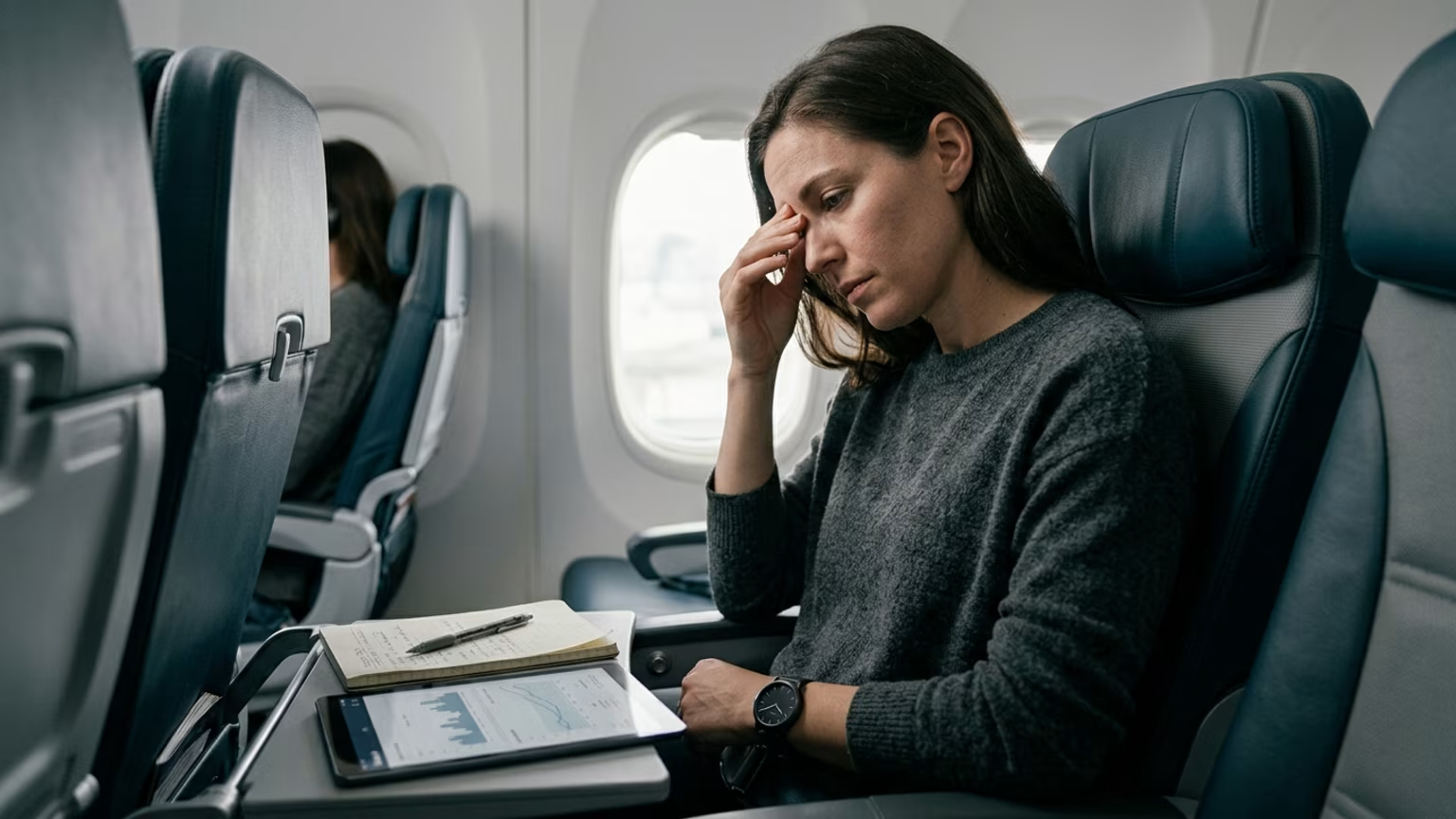
The results provide a highly useful framework for operators and founders. I remember landing at Heathrow after a brutal overnight flight from New York. I had a board meeting in three hours. The standard advice of getting eight hours of sleep felt like a cruel joke.
That was the exact moment I realized our readers do not need perfect scenarios. They need triage protocols. They need to know what the science says about recovering cognitive function when you only managed three hours of terrible sleep at high altitude. While a five-dollar reward is clearly not the answer for a busy CEO, the underlying mechanics of the Pittsburgh study apply directly to executive performance.
The combination of a specific target, objective measurement, and rapid feedback is a reliable structure. Leaders can apply this by treating sleep as a strict execution variable. You can build a reliable evening structure by defining a measurable threshold for yourself. A team seeking better recovery could monitor bedtime consistency or track nights meeting a pre-agreed sleep target.
Immediate feedback creates a short loop between daily behavior and performance data. This approach is highly relevant for professionals aiming to support their cognitive performance and mental clarity over the long term. The key is finding a consequence or a tracking metric that feels meaningful to the individual. Consistent measurement turns an abstract goal into a manageable operational priority.
If the objective is executive performance, organizations should predefine specific operational outcomes. Leaders can measure decision latency, error rates, or sustainable work capacity. It is a mistake to assume that additional sleep automatically translates into improved company results. The strongest defensible conclusion is that immediate financial incentives increased sleep duration in this specific sample.
The financial incentive produced clear and measurable changes in sleep behavior. In this University of Pittsburgh student study, participants offered money slept an average of 19 additional minutes per school night. The incentive group also reached at least seven hours of sleep on 26% more nights than the comparison group. These figures demonstrate a significant shift in daily habits when immediate consequences are introduced.
The benefits also extended to measured academic outcomes. The study's reporting described an average GPA increase of about 0.08 points among rewarded students. This suggests that the intervention improved an observable performance metric alongside the primary behavioral target. The sleep improvement did not disappear immediately after payments stopped.
Participating students continued to sleep approximately eight minutes longer per night during the remaining three to four weeks of the study. It is worth noting the role of the nonfinancial components in these results. The Guardian reported that reminders and morning feedback alone had little effect in this experiment. The digital tracking created visibility, but the monetary incentive ultimately drove the behavioral change.
This distinction is critical for anyone designing programs to improve stress resilience and sustainable performance. The data indicates that awareness is rarely sufficient to change behavior on its own. An average gain of 19 minutes per night represents a valuable cumulative increase in weekly recovery time. These metrics validate the idea that targeted incentives can successfully alter evening routines.
ExecuFuel evaluates all research based on its strict methodological limits. The findings are directly about university students, so their relevance to executives remains an open question. The participants had an average age of approximately 19. A workplace program involving seasoned operators would face entirely different physiological demands, travel schedules, and stress profiles.
The timeframe of the study serves as another critical boundary. The intervention lasted four weeks, so the study does not establish whether financial incentives would sustain improved sleep over many months or years. Although sleep remained approximately eight minutes longer after payments stopped, that persistence was observed only over the remaining three to four weeks covered by the study. We do not know if the habit would endure over a full operational year.
Furthermore, the measurement tools possess distinct technical limitations. Wearable-derived sleep estimates are useful for monitoring behavior but are not equivalent to a clinical diagnosis or a full assessment of sleep quality. The available coverage confirms that Fitbits were used to verify sleep duration, but it does not establish clinical-grade diagnostic accuracy. A complete picture of healthy aging and executive longevity requires much more than wrist-based tracking.
Finally, the seven-hour target is specific to this study design. It should not be interpreted as the universally optimal amount of sleep for every adult. Individual sleep needs vary significantly based on genetics, daily cognitive load, and accumulated recovery debt. The reported academic results also cannot be generalized automatically to business outcomes like revenue generation or decision quality.
There are potential ethical and cultural concerns around paying people to perform basic health behaviors. A workplace program could be perceived as coercive or unfair if it requires employees to share personal sleep data. It might inadvertently penalize people whose demanding schedules or health conditions limit their sleep. Any organizational initiative must respect privacy and maintain strict professional boundaries.
This study signals a growing integration between behavioral economics and daily recovery practices. The findings encourage a necessary move away from passive advice toward highly structured adherence models. We expect future research to test noncash incentives in demanding professional settings. Organizations might explore protected meeting-free mornings, schedule flexibility, or team-based recovery goals in upcoming clinical trials.
The next phase of behavioral research will likely evaluate long-term habit formation. Scientists will need to study whether these changes persist many months after an intervention ends. As wearables improve in accuracy, researchers can pair behavioral incentives with deeper physiological metrics. Future studies might track sleep architecture, autonomic nervous system recovery, and hormonal balance alongside simple duration.
For now, operators can learn heavily from the basic mechanics of the study. You can implement specific targets, use objective measurement, and establish rapid feedback loops in your own life. Consistent tracking and clear consequences form the foundation of reliable human performance. By treating sleep with the exact same rigor as business execution, professionals can protect their capacity for highly demanding work.
Stay connected for research and practical guidance on executive performance, energy, focus, sleep, recovery and longevity. Ideas built for people who want to stay sharp, capable and effective for the long run.




Build habits and systems that support clear thinking, steady energy and long term capacity throughout a demanding career.
explore the Blog