
Washington State University researchers outline a new wearable protocol pairing continuous fatigue data with vigilance testing to measure true workforce readiness.





On September 21, 2026, Washington State University’s College of Nursing published “Using Wearables to Improve Health Outcomes”. The report outlines work by researchers investigating digital health applications for tracking sleep, fatigue, and workforce readiness. The primary focus of the new publication is a proposed research study aimed at shift-working nurses. The approach offers a practical model for identifying fatigue-related risk without relying entirely on subjective self-reporting.
The distinction between assumed capability and documented readiness is a growing focus across demanding industries. Organizations are increasingly looking for ways to measure actual exhaustion before it compromises critical operational tasks. By combining continuous biometric tracking with active behavioral tests, researchers hope to create a clearer picture of human capacity. This effort reflects a broader movement toward objective safety standards in high-stress work environments.
The most relevant development in the WSU publication is a proposed Agency for Healthcare Research and Quality R01 study. Lois James, director of the Sleep and Performance Research Center at WSU, is leading the proposal. The article clearly describes the study as being under review rather than an awarded or completed project. If approved, the research will combine continuous tracking with point-in-time performance checks to assess fatigue levels.
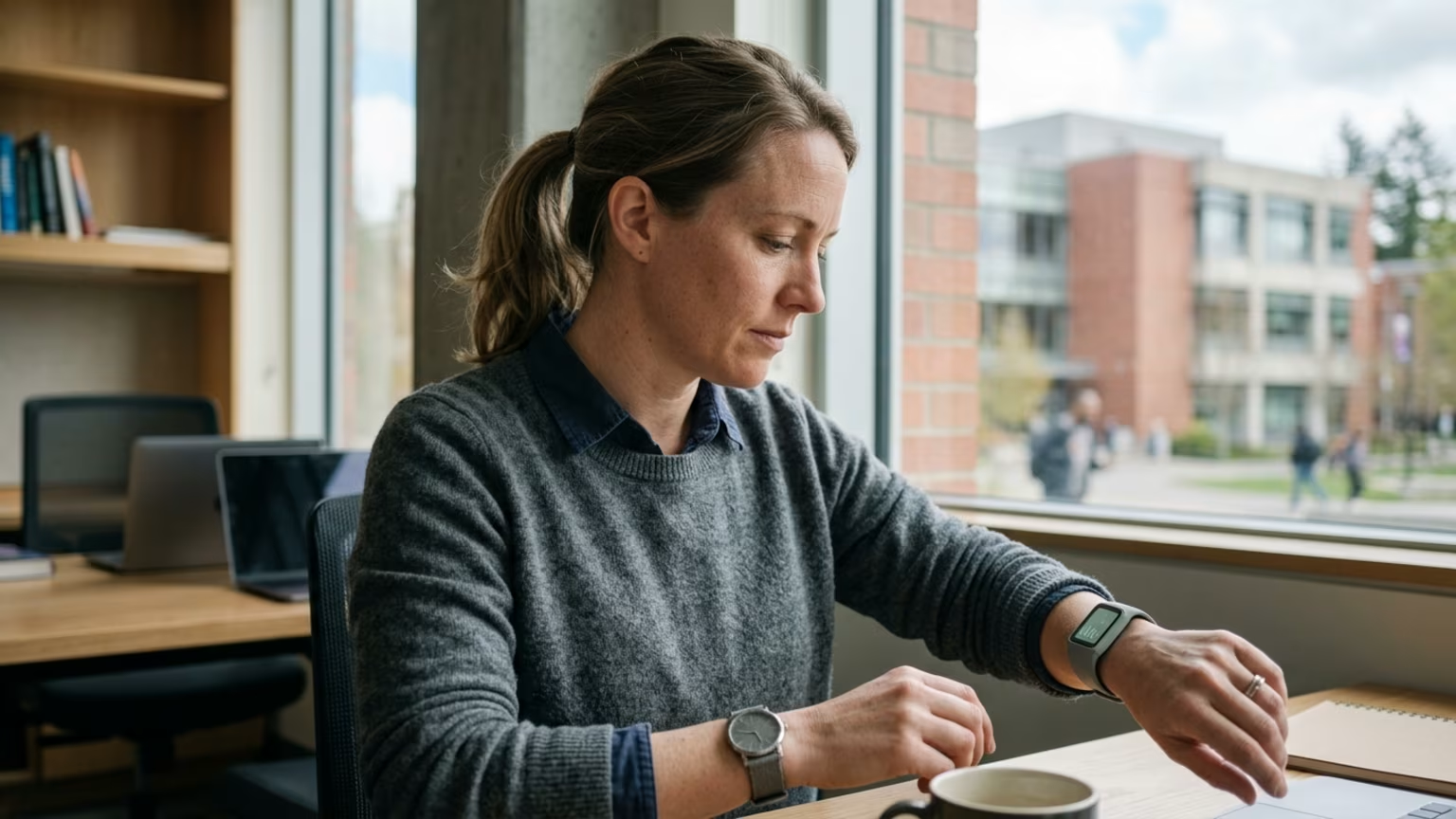
The methodology relies on pairing passive device data with an active behavioral test. The study would use ReadiWatch devices made by Fatigue Sciences to monitor sleep and activity patterns. Those metrics allow the system to calculate a SAFTE score. WSU describes SAFTE as a measure for estimating fatigue and readiness for demanding tasks.
The SAFTE measure is then paired with a web-based psychomotor-vigilance test, commonly known as a PVT. This combination creates a two-part assessment to help nurses better understand their capacity for patient care. The proposal builds upon the completed Providence Nurses’ Health Study. That earlier project used ReadiBand devices to examine the diet, exercise, and sleep habits of full-time nurses during the COVID-19 pandemic.
Ross Bindler, a research investigator at the College of Nursing, highlighted the challenge of practical application. Bindler said, “I think teaching individuals how to turn the data into useful information is still the biggest part.” This perspective perfectly aligns with the core philosophy we maintain at ExecuFuel.
I spent a week at a popular health optimization conference and left completely exhausted by the complexity. Everyone was pushing a new supplement protocol, a complicated gadget, or a rigid daily routine.
It struck me that true high performers do not have time to make health a full time job. They need maximum return on minimum viable effort. That observation became the filter for every piece of research we publish.
Organizations must interpret incoming data within their specific clinical or operational scope. Nurses and operators alike possess the expertise to use these signals effectively. Bindler frames the WSU project as an interpretation and decision support effort rather than a simple data collection exercise. The ultimate goal is moving from raw metrics to informed operational changes.
The distinction between feeling alert and being capable of sustained attention matters deeply for high-stress roles. Subjective alertness can be misleading when professionals operate under extreme pressure or chronic sleep debt. A psychomotor-vigilance test provides a concrete behavioral measure of vigilance that surveys often miss. Combining these tools gives leaders a more accurate picture of their capacity to sustain sustainable executive performance.
The WSU proposal outlines a clear operational framework that executive teams can adapt for their own environments. First, organizations must measure readiness as a decision support signal rather than a final verdict on capability. A wearable score can help identify broad patterns in activity and fatigue over time. A brief vigilance test adds an observable performance dimension, but neither perfectly captures complex judgment or leadership capacity.
Second, teams should pair passive data collection with active testing protocols. The proposed WSU design creates a model where longitudinal recovery data is supplemented by point-in-time checks. This dual approach is highly defensible for organizations managing high stakes operations. It provides a more robust safety net than relying entirely on subjective assessments or a single consumer score.
Third, leaders can use aggregate trends to improve broader operational scheduling systems. Teams can model fatigue risk across travel-heavy calendars, late night product launches, and repeated early morning meetings. Executive planners can adjust schedules proactively when data reveals a compounding risk of exhaustion. This systematic approach allows companies to protect their top performers from severe burnout before it happens.
Fourth, management must design interventions around recovery rather than focusing on monitoring for its own sake. WSU clearly describes sleep education for nurses as the core purpose of their proposed research. In an executive setting, measurement must lead to concrete actions such as establishing protected rest windows. When fatigue patterns persist, leaders should initiate workload changes or enforce mandatory recovery time to maintain sharp mental clarity.
The WSU publication shares context on device adoption through previous research efforts. The RELIEF Pain Hub trial distributed more than 100 Fitbit Inspire 3 devices to participants. WSU reports that 84 of 100 participants successfully activated their devices and provided data. This high activation rate suggests that professionals are willing to engage with workplace monitoring technology.
Broader research confirms the severe toll that demanding schedules take on essential recovery. A recent meta-regression involving 280 unique studies reported a significant 28.7-minute decline in nurses’ sleep duration. The same comprehensive review found a 1.6-point reduction in overall sleep quality. These figures underscore the vital need for objective fatigue tracking in high-stakes environments.
The WSU project is strictly a proposal under review and must not be treated as a completed clinical trial. The university article provides no numerical SAFTE thresholds, testing schedules, or numerical fatigue outcomes for the proposed study. Furthermore, the combination of a wearable and a PVT has not yet proven to improve patient care outcomes. Intellectual honesty requires acknowledging that a SAFTE score is not a direct observation of cognitive performance.
Wearable estimates also come with inherent technological limitations that vary widely by device. A recent review of intensive care nursing applications noted that agreement with physiological sleep measures is highly inconsistent. The accuracy of these estimates changes based on the specific device, patient state, and age of the user. Therefore, these tools should support clinical context rather than serving as stand-alone measurements.
Device design and physical movement can significantly affect the reliability of wearable sleep estimates. A monitor might detect a period of low movement without proving that the wearer actually achieved restful sleep. The WSU article warns that accuracy and validation vary dramatically across different commercial products. These technical constraints mean that raw data always requires careful human interpretation.
Bindler offered a clear warning about the current state of the commercial technology market. He cautioned that “some of these smaller companies that are developing some of these new products, they should be taken with caution”. He noted that many companies make “lofty claims” without providing sufficient clinical validation. He added, “No one should think that any one device is a magic device that's going to improve everything.”
Finally, objective metrics are not meant to entirely replace human feedback. The WSU article explicitly states that surveys and self-reported information remain highly important for comprehensive assessments. The proposed nurse study aims to add performance-based data rather than discard subjective reports entirely. A complete picture requires both the raw digital numbers and the subjective human context behind them.
The future of fatigue tracking depends heavily on establishing strict privacy and governance rules first. WSU identifies data security, technology access, device connectivity, and variable accuracy as practical barriers to widespread adoption. Organizations must clearly define who can view fatigue data and how long these personal records are retained. They must also ensure that scores are not misused for punitive surveillance or simplistic employee evaluations.
Measurement programs must lead to concrete operational changes rather than merely generating passive digital dashboards. WSU describes sleep education as the ultimate practical purpose of the proposed nursing study. In corporate settings, tracking should directly trigger workload adjustments or enforce protected rest periods when fatigue patterns persist. Leaders must focus on building structured sleep recovery systems that genuinely support their highest performing teams.
Investors and operators should demand rigorous validation before buying new monitoring technology at scale. They should seek independent accuracy data and ask for evidence that the measurement actually improves operational outcomes. Bindler accurately described the cost of these comprehensive systems as “a gigantic hurdle” for widespread commercial implementation. As the science matures, the organizations that pair reliable data with thoughtful interpretation will gain a significant performance advantage.
Stay connected for research and practical guidance on executive performance, energy, focus, sleep, recovery and longevity. Ideas built for people who want to stay sharp, capable and effective for the long run.




Build habits and systems that support clear thinking, steady energy and long term capacity throughout a demanding career.
explore the Blog