
Cardiovascular fitness and muscle size dominate longevity discussions, but dynamic balance and neuromuscular coordination are what truly protect your physical independence over time.





Most longevity protocols focus almost exclusively on cardiovascular metrics like VO2 max or absolute resistance numbers in the gym. While aerobic endurance and muscular mass are vital, they represent an incomplete picture of biological resilience. You can possess exceptional cardiovascular health and strong leg press numbers, yet still suffer a life-altering fall if your nervous system cannot quickly correct a stumble on an icy curb. True physical independence across the lifespan requires postural stability, rapid neuromuscular control, and precise coordination under cognitive load.
Balance is rarely trained with the same deliberate structure as strength or conditioning. Instead, it is often relegated to standing passively on one foot or balancing on an unstable foam pad at the end of a workout. Research shows that static balance drills do not automatically translate to dynamic movement or fall prevention. To build durable functional capacity, you must understand how sensory systems, muscular power, and motor coordination interact in demanding environments.
Balance is not an isolated muscular quality. Clinically, balance is defined as the ability to maintain and control your center of mass relative to your base of support. When you stand still, your base of support consists of the surface area beneath and between your feet. The moment you initiate a step, your base of support narrows, and your center of mass shifts forward into temporary instability. Postural control is the continuous management of this instability across static, dynamic, and unpredictable conditions.
The central nervous system manages balance by synthesizing input from three distinct sensory pathways. The somatosensory system provides proprioceptive data from mechanoreceptors in muscles, tendons, joint capsules, and the soles of the feet. This informs the brain about joint angles, muscle tension, and surface texture. The visual system provides a reference frame relative to external objects and horizon lines. The vestibular system, located within the inner ear, detects linear acceleration, angular head rotation, and gravitational orientation.
When all three sensory systems operate normally, the brain blends their signals seamlessly to generate corrective muscle actions. When one system is compromised, such as walking in a dark room or dealing with vestibular inflammation, the nervous system relies on sensory reweighting. It increases reliance on the remaining functional senses to maintain orientation. Training must challenge this reweighting process systematically without causing injury.
True movement resilience also requires a distinction between rigid stability and adaptable stability. Rigid stability involves tensing every muscle to prevent movement, which is an inefficient strategy that increases fatigue and limits reaction speed. Adaptable stability allows your joints to remain mobile and responsive. It enables your center of mass to adjust smoothly to changing terrain, unexpected bumps, or shifting loads.
Muscular strength and rate of force development are the physical engines of this system. If you stumble, sensory recognition of the fall happens within milliseconds. If your lower body lacks the strength or power to drive your foot into the floor rapidly, that sensory awareness cannot prevent a fall. This is why our approach to energy, strength and physical performance treats balance and resistance training as unified disciplines.
Decades of epidemiological and clinical trial data demonstrate that physical decline in balance is neither instantaneous nor entirely unavoidable. Age-related reductions in nerve conduction velocity, muscle spindle sensitivity, and type II fast-twitch muscle fibers begin in midlife. However, structured physical interventions can preserve these systems.
A comprehensive Cochrane systematic review evaluated 59 randomized controlled trials involving 12,981 participants. The researchers found that structured exercise reduced the overall rate of falls in community-dwelling older adults by 23 percent. When the interventions specifically emphasized balance and functional exercises, the rate of falls dropped by 24 percent, and the absolute number of individuals experiencing a fall fell by 13 percent.
The data also show that multicomponent programs yield the most substantial reductions. Combining progressive resistance training with functional balance drills reduced fall rates by approximately 28 percent. Tai chi interventions demonstrated a 19 percent reduction in fall rate, though the certainty of evidence was lower than for combined strength and balance protocols.
Based on this evidence base, the World Health Organization recommends that adults aged 65 and older participate in varied multicomponent physical activity at least three days per week. These sessions must prioritize functional balance and muscle-strengthening exercises at moderate or greater intensity. International clinical fall prevention guidelines echo this timeline. They state that interventions should run for a minimum of 12 weeks to generate meaningful neuromuscular adaptations, with greater benefits occurring through lifelong practice.
More recent research focuses on perturbation-based balance training. This method exposes individuals to controlled, unexpected mechanical disturbances in a supervised environment, such as sudden floor translations or tether releases. Systematic reviews show that perturbation training improves reactive stepping mechanics and can reduce real-world falls by roughly 23 percent and injurious falls by 24 percent. Controlled perturbation forces the nervous system to practice automated recovery strategies rather than relying solely on conscious correction.
I spent a week at a popular health optimization conference and left completely exhausted by the complexity. Everyone was pushing a new supplement protocol, a complicated gadget, or a rigid daily routine. It struck me that true high performers do not have time to make health a full time job. They need maximum return on minimum viable effort. That observation became the filter for every piece of research we publish across our longevity and healthspan resources.
Balance is often discussed as an issue relevant only to geriatric populations. This narrow perspective overlooks how high-stress professional environments degrade motor control and joint stability long before old age. Extended sitting in transatlantic flights, chronic sleep deprivation, and intense cognitive fatigue directly impair nervous system processing speed.
When you walk through a busy international airport while checking emails on your smartphone, your brain must manage dual-task interference. Cognitive-motor dual-tasking splits attention between spatial navigation and analytical problem-solving. Research demonstrates that dividing cognitive attention significantly increases gait variability and slows down reactive stepping speed. If you clip the edge of an escalator or encounter a slick marble floor while distracted, your probability of a severe sprain or fall increases.
Asymmetrical loads compound this risk. Carrying a heavy laptop bag or rolling suitcase down a flight of stairs shifts your center of mass away from your midline. If your core stabilizers, hip abductors, and foot intrinsic muscles are unconditioned, your body will compensate by stiffening the spine and shortening stride length. Over time, this creates muscular imbalances, reduces ankle mobility, and leaves you vulnerable to acute injury during recreational sports or daily travel.
Executive performance requires physical dependability under pressure. Maintaining sharp motor control ensures that joint integrity and movement confidence remain high, even when traveling under demanding schedules. Integrating balance work into your existing physical routine prevents the gradual physical compromises that derail long-term productivity.
To create an effective balance program, avoid treating it as a single exercise. Instead, address the seven primary domains that govern human locomotion and stability.
Muscular strength provides the physical capacity to control joint angles and absorb ground impact forces. Muscular power, or the rate of force development, dictates how rapidly your muscles can contract to reposition your feet when your balance is disrupted.
Key movement patterns must target the quadriceps, hamstrings, gluteus medius, gastrocnemius, soleus, and tibialis anterior. The gluteus medius stabilizes the pelvis during single-leg stance, preventing the opposite hip from dropping during walking. The ankle musculature executes rapid plantarflexion and dorsiflexion adjustments to maintain center of mass over the feet.
When performing step-ups, avoid pushing off the rear foot. Force the working front leg to generate all the upward propulsion, then pause for two seconds in a balanced single-leg stance at the top. For suitcase carries, maintain a completely vertical torso without leaning away from the load. This trains lateral hip and trunk stabilizers against asymmetric forces.
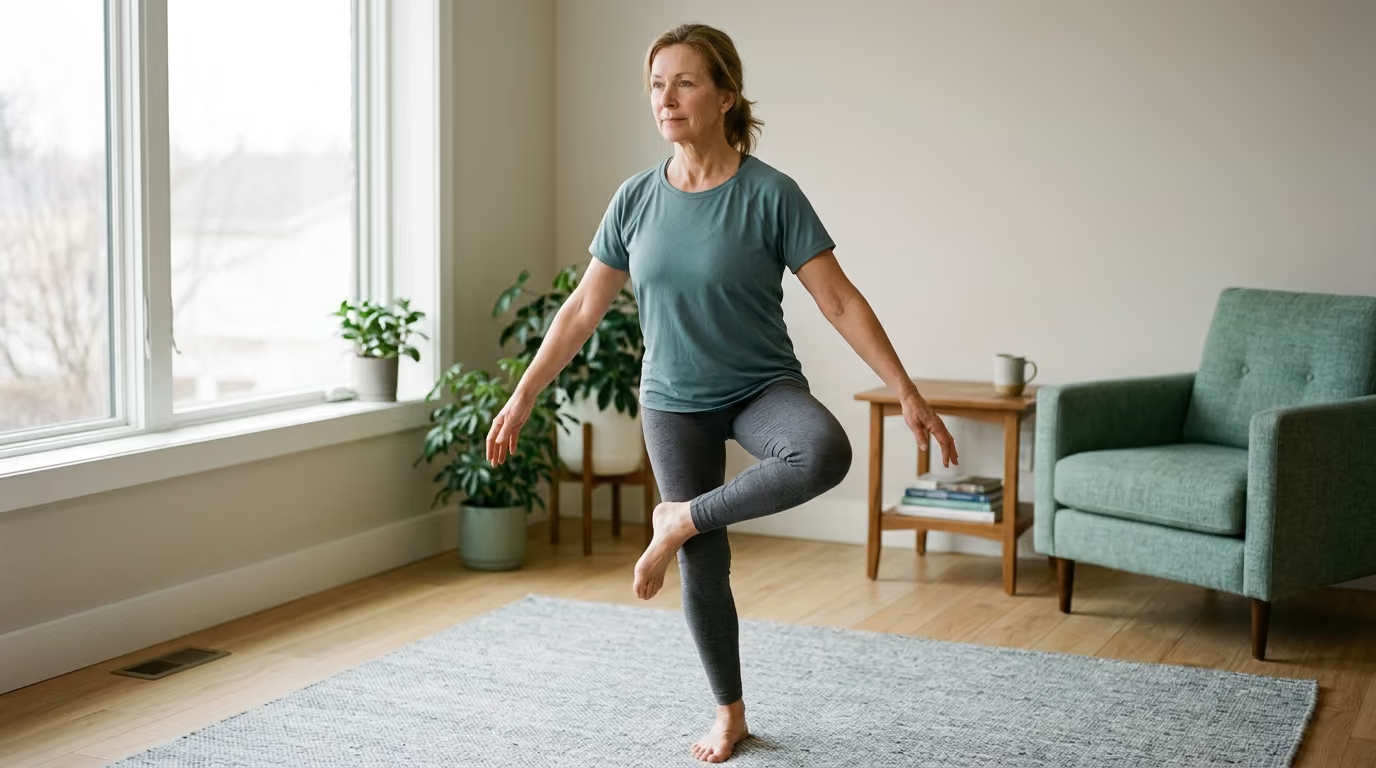
Static postural control refers to maintaining stability while your feet remain anchored in a stationary position. It serves as the baseline for sensory integration and ankle-hip balance strategies.
Progression must systematically reduce the base of support. You begin with a standard two-foot stance, progress to a narrow stance with feet touching, move to a semi-tandem stance, advance to a full tandem heel-to-toe stance, and conclude with a single-leg stance.
During static drills, focus on maintaining three points of contact on each foot: the base of the big toe, the base of the small toe, and the heel. Avoid gripping the floor excessively with your toes, which indicates over-reliance on superficial foot flexors. Once you can hold a single-leg stance for 30 seconds with clean mechanics, introduce slow head rotations from left to right to challenge the vestibular system.
Dynamic balance involves controlling the center of mass while the body is in motion. This requires continuous sensory updates as your feet leave and rejoin the ground.
Training dynamic stability involves moving along different planes of motion. Linear movement must be paired with lateral side-stepping, backward walking, and rotational patterns.
When executing tandem walking, maintain a tall posture and look forward toward the horizon rather than down at your feet. In backward walking, ensure you step straight back, rolling from toe to heel, while staying aware of your spatial surroundings.
Real-world walking requires adjusting stride length, walking speed, and foot placement in response to environmental obstacles. A rigid, unvarying gait increases trip risk on uneven terrain.
Gait adaptability training introduces deliberate variations into walking mechanics. This includes sudden speed shifts, negotiated obstacles, and cognitive dual-task challenges.
Dual-task drills force your brain to automate motor control while conscious processing is occupied with cognitive tasks. Ensure that base gait mechanics remain stable before adding complex arithmetic or conversational loads.
Reactive balance is the body’s involuntary response to an unexpected displacement. When a slip or trip occurs, you must execute a rapid recovery step or hip adjustment to establish a new base of support.
Reactive training shifts the stimulus from self-initiated movements to externally prompted actions. This bridges the gap between structured gym exercises and real-world slips.
Safety is paramount during reactive training. Maintain a clear perimeter free of sharp equipment, and utilize wall rails or spotters when working with individuals with elevated fall risk.
Coordination is the precise temporal and spatial sequencing of muscle activations across multiple limbs. It requires cooperation between the cerebellum, basal ganglia, and motor cortex.
Coordination improves when you solve movement puzzles that break standard repetitive patterns. Exercises should require interlimb dissociation, where arms and legs perform different rhythmic tasks simultaneously.
Focus on movement quality over raw speed. Smooth, deliberate movements establish clear motor engrams in the nervous system, which can later be executed at higher velocities.
Restricted range of motion in the ankles, hips, and thoracic spine compromises your balance strategies. For instance, limited ankle dorsiflexion prevents your lower leg from tilting forward naturally during walking, causing premature heel lift and trip hazards.
Transitional movement involves moving between different levels, such as moving from the floor to a standing position. Floor-to-stand transitions build confidence, spatial awareness, and full-body functional strength.
Practice floor-to-stand get-ups using different paths, including half-kneeling, cross-legged, and side-sit transitions. This builds adaptable movement options for unpredictable environments.
To design an effective protocol, you must measure your current functional capacity. Clinical balance screening uses validated, reliable tools that evaluate fall risk and motor competence.
The Centers for Disease Control and Prevention STEADI framework outlines three primary screening questions. First, have you fallen in the past year? Second, do you feel unsteady when standing or walking? Third, do you worry about falling? Answering yes to any of these questions warrants a structured functional evaluation.
The Timed Up and Go test evaluates dynamic balance, sit-to-stand mechanics, gait velocity, and turning stability. A completion time greater than 12 seconds correlates with an increased risk of falls in community-dwelling adults. Healthy middle-aged adults typically complete this test in under nine seconds.
When tracking progress during training, monitor qualitative movement markers alongside test times. Note whether you rely on excessive trunk lean, breath holding, or foot gripping to maintain balance. As your balance improves, your movement should appear relaxed, quiet, and effortless.
You do not need an entirely separate training session for balance. The most time-efficient approach embeds balance challenges directly into your existing strength, mobility, and conditioning workouts. This ensures regular exposure without adding hours to your weekly schedule.
During the warm-up, use balance drills as neural priming exercises. Because the nervous system is fresh, this is the optimal window to perform low-fatigue coordination tasks like tandem walking, single-leg reaches, and ankle mobility drills.
In the strength block, select exercises that challenge stability on a solid floor. Unilateral movements, such as Bulgarian split squats and single-leg Romanian deadlifts, develop immense lower-body strength while training hip stabilizers. Avoid performing heavy resistance training on unstable surfaces like wobble boards. Standing on compliant surfaces significantly reduces force output and increases joint injury risk without improving athletic power.
For practical guidance on structuring total training volume, review our definitive frameworks on executive performance management.
Demanding travel schedules and back-to-back professional commitments often make full gym workouts impractical. During these periods, you can maintain balance and coordination using zero-equipment micro-sessions in a hotel room or office.
Perform this sequence upon waking or before dinner during business travel. It reactivates the nervous system after long flights, restores ankle dorsiflexion, and reinforces lateral hip stability.
When travel fatigue is severe, adjust your exercise selection. Do not perform high-speed reactive stepping drills or complex agility ladder movements when you are sleep-deprived. Fatigue impairs reaction times and increases the risk of an acute joint sprain. Under high fatigue, focus on controlled static balance, slow eccentric strength, and gentle mobility work.
You can also weave micro-habits into daily transit. When standing on a subway train or airport tram, practice holding your stance lightly without gripping the handrail, keeping your hands hovering inches above it for immediate safety. When brushing your teeth in the morning, perform a 30-second single-leg stance on each foot. These brief exposures accumulate meaningful training volume over time.
To maximize safety and effectiveness, avoid common fitness industry misconceptions surrounding balance training.
The belief that unstable equipment is superior for balance is unsupported by sports science. While balancing on a foam pad or inflatable disc challenges foot proprioceptors, it alters ground reaction forces and prevents the generation of high muscular torque. Solid-ground unilateral training provides superior transfer to real-world movement by allowing higher resistance loads while preserving natural foot biomechanics.
Closing your eyes is another frequently misused progression. Removing visual input forces dependence on vestibular and proprioceptive inputs. However, for individuals with diabetic neuropathy, severe vestibular hypofunction, or history of stroke, closing the eyes can cause an immediate fall. Visual occlusion should only be introduced when an individual exhibits stable single-leg control on solid ground with hand support nearby.
It is equally vital to recognize the boundaries of exercise science. Balance training significantly reduces fall rates, but it cannot eliminate falls entirely. Falls are multifactorial events influenced by environmental hazards, acute illness, syncopal episodes, and medication interactions. Psychoactive medications, sedatives, and antihypertensive drugs that induce orthostatic hypotension are primary clinical contributors to falls.
For individuals managing complex conditions like Parkinson's disease, peripheral neuropathy, or advanced osteoporosis, generic exercise progressions may be inappropriate. These populations require individualized clinical exercise protocols designed by a licensed physical therapist or medical specialist. For broader insights on maintaining functional resilience across decades, read our guide on healthy aging and longevity architecture.
Long-term physical autonomy is built through consistent, progressive training that challenges your strength, coordination, and nervous system across every decade of life.
Stay connected for research and practical guidance on executive performance, energy, focus, sleep, recovery and longevity. Ideas built for people who want to stay sharp, capable and effective for the long run.


Build habits and systems that support clear thinking, steady energy and long term capacity throughout a demanding career.
explore the Blog