
A new cross-sectional study maps how sleep apnea and insomnia alter brain fluid dynamics, revealing measurable cognitive and memory deficits in older adults.





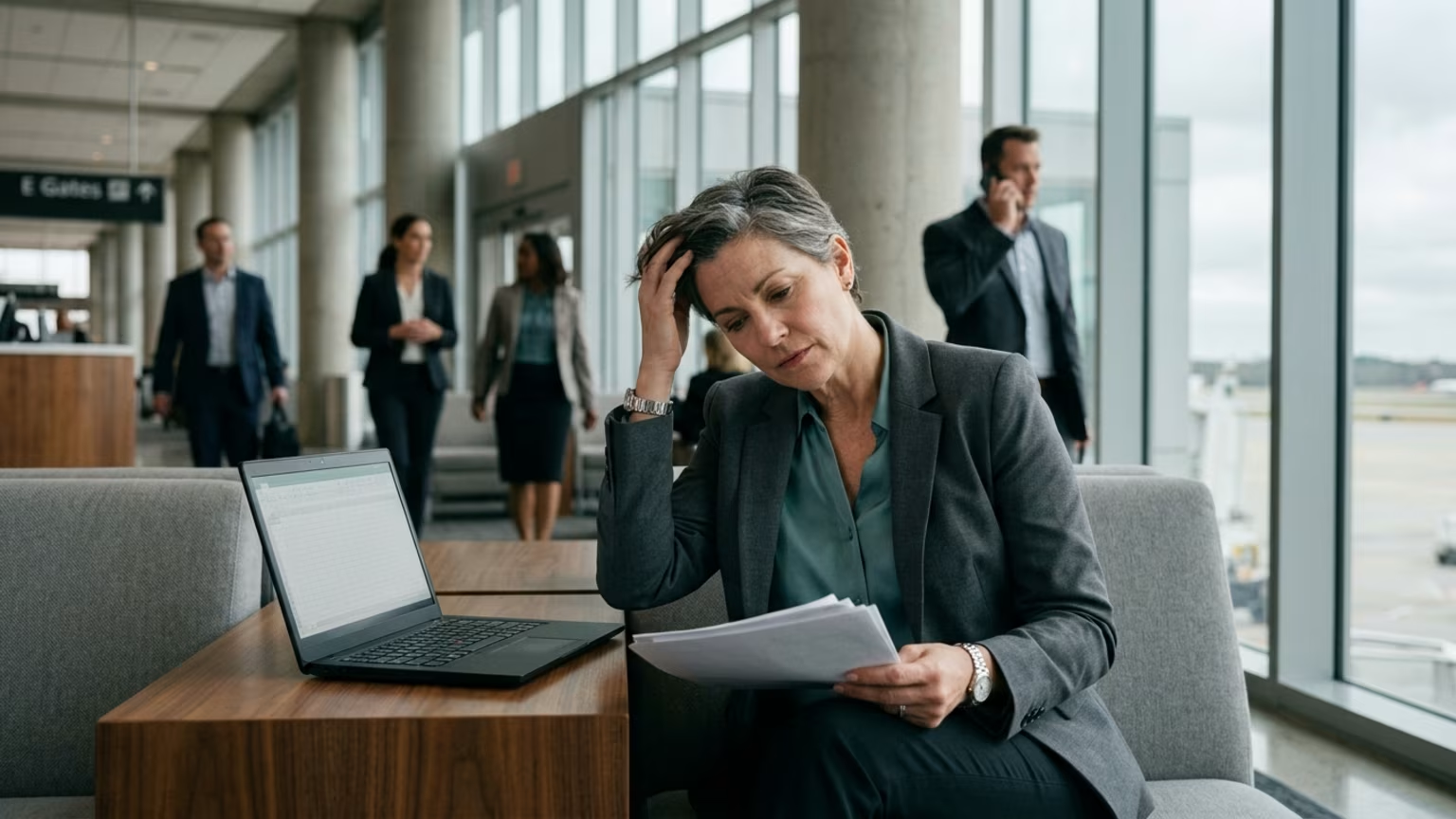
A chief financial officer stares at a quarterly report, reading the same paragraph three times. The numbers blur, a mild headache sets in, and another cup of coffee fails to clear the fog. This is not just temporary fatigue. Macro-scale glymphatic activity is the biological mechanism that flushes metabolic waste from the brain during sleep. A new cross-sectional study in Nature and Science of Sleep examined whether specific sleep disorders disrupt this critical maintenance system. The findings point to measurable vulnerabilities in fluid dynamics and cognitive performance for affected adults.
The researchers investigated obstructive sleep apnea, insomnia, and comorbid insomnia-sleep apnea. They focused on adults aged 50 to 80 to measure cognitive performance and brain fluid dynamics. The study recruited 143 participants initially. After excluding 12 participants for excessive head motion during MRI preprocessing, they analyzed 30 healthy controls. The final cohort also included 46 participants with OSA, 32 with insomnia, and 35 with COMISA.
Participants underwent a rigorous sequence of physical and mental evaluations. The testing protocol included resting-state functional MRI and overnight home sleep-apnea testing. The cognitive battery featured the Montreal Cognitive Assessment and the Auditory Verbal Learning Test. It also included Trail Making Tests, Stroop tests, and the Clock Drawing Test. This comprehensive approach ensured researchers captured a broad spectrum of executive functions.
The team measured the coupling between the global blood-oxygen-level-dependent signal and cerebrospinal-fluid dynamics. This metric is known as gBOLD-CSF coupling. It serves as a non-invasive surrogate measure of macro-scale glymphatic activity. All three sleep-disorder groups showed significantly weaker gBOLD-CSF coupling than healthy controls after covariate balancing. The weighted analysis revealed a large overall group effect with F=29.25, p<0.001, and partial η²=0.387.
COMISA produced the most pronounced reduction in this critical coupling metric. Its coupling was significantly lower than isolated OSA (p=0.005) and isolated insomnia (p=0.001). The effect sizes for the between-group comparisons ranged from Cohen’s d=0.63 to d=1.52. This indicates moderate-to-large differences within this sample. Participants with sleep disorders generally performed worse than healthy controls on cognitive measures. Their reported corrected p-values ranged from 0.001 to 0.046.
Cognitive deficits were distinct across the different sleep conditions. COMISA participants performed worse than the insomnia-only group on 20-minute delayed auditory-verbal recall (p=0.047). Insomnia and COMISA participants took significantly longer than healthy controls on Trail Making Test B. This test measures executive functioning and cognitive flexibility, with p-values ranging from 0.006 to 0.009. Among participants with OSA or COMISA, weaker coupling was heavily associated with respiratory burden.
The apnea-hypopnea index correlated with coupling at r=0.397 after covariate adjustment. Oxygen-desaturation index correlated at r=0.338, time spent below 90 percent oxygen saturation at r=0.337, and lowest oxygen saturation at r=-0.305. The study found that gBOLD-CSF coupling was associated with delayed episodic memory in the OSA/COMISA subgroup. This relationship showed r=-0.367 and p=0.02 after false-discovery-rate correction.
Statistical mediation models provided further insight into the potential mechanics of memory loss. These models indicated that gBOLD-CSF coupling partially mediated the associations between respiratory metrics and delayed episodic-memory performance. The reported indirect effects were -0.092 for AHI, -0.079 for oxygen-desaturation index, and -0.111 for time below 90 percent oxygen saturation. Their bootstrap confidence intervals excluded zero, pointing to a measurable biological pathway.
Founders often treat chronic sleep disruption as a mere productivity inconvenience rather than a structural health threat. They push through the morning fog, assuming that a high-stress role naturally comes with a degree of physical penalty. I remember landing at Heathrow after a brutal overnight flight from New York. I had a board meeting in three hours. The standard advice of getting eight hours of sleep felt like a cruel joke. That was the exact moment I realized our readers do not need perfect scenarios.
They need triage protocols. They need to know what the science says about recovering cognitive function when you only managed three hours of terrible sleep at high altitude. While acute sleep loss requires immediate mitigation, chronic sleep disorders demand clinical intervention. Subjective sleep quality plays a massive role in day-to-day executive function. Across the full sample, weaker coupling was associated with poorer subjective sleep quality. The adjusted partial r was 0.261 with p=0.004 before false-discovery-rate correction.
Among participants with sleep disorders, coupling was also associated with global cognition on the MoCA. The adjusted partial correlation was r=-0.210 with p=0.036. A separate 2026 study reported that comorbid insomnia among patients newly diagnosed with OSA was associated with a sustained increase in dementia risk. This specific finding addresses long-term observational risk rather than the MRI-based glymphatic mechanism. However, it underscores the severe consequences of ignoring persistent markers of stress and burnout.
Treating these conditions requires a precise, phenotype-specific approach rather than generic lifestyle advice. Sleep health management must adapt because COMISA may not be adequately represented by treating respiratory events alone. Clinical reviews suggest some COMISA patients continue to experience insomnia, fatigue, cognitive complaints, or fragmented sleep perception. This happens even after respiratory control improves with positive airway pressure therapy.
For diagnosed OSA, current clinical guidance supports PAP treatment in appropriate patients. Clinicians use continuous or auto-adjusting PAP as ongoing treatment options to manage respiratory disruptions. This guidance emphasizes education, troubleshooting, and follow-up to support treatment adherence. If a professional struggles with a mask, the clinical protocol involves resolving the discomfort rather than abandoning the therapy entirely.
For chronic insomnia, cognitive behavioral therapy for insomnia is recommended as a first-line treatment approach. CBT-I addresses the psychological and behavioral patterns that sustain poor sleep architecture. You cannot reliably diagnose these complex disorders from a consumer wristband. Home testing may be appropriate for some adults, but polysomnography remains preferred in higher-complexity clinical situations. Building a foundation for cognitive performance and mental clarity requires accurate diagnostics.
Building resilience for executive performance requires maintaining the brain's biological maintenance systems over decades. The authors interpret that altered gBOLD-CSF coupling may provide an early physiological marker of cognitive vulnerability. This marker points specifically to episodic-memory impairment in OSA and COMISA. Glymphatic dysfunction may serve as a convergent biological endpoint across different sleep-disorder phenotypes.
It is vital to maintain scientific precision when interpreting these results. The findings do not establish that sleep disorders cause impaired clearance or cognitive decline directly. The gBOLD-CSF measure is a non-invasive surrogate for macro-scale glymphatic activity. It is not a direct measurement of molecular waste clearance or proof that specific proteins accumulated in the participants’ brains.
A rigorous approach to healthy aging and executive longevity means acting on early indicators. The study did not find a significant direct association between AHI and delayed episodic memory, suggesting the pathway is complex. Treat chronic sleep disruption as a potential health issue rather than a badge of honor. If you experience persistent snoring, witnessed apneas, or chronic awakenings, schedule a formal clinical evaluation this week.
Stay connected for research and practical guidance on executive performance, energy, focus, sleep, recovery and longevity. Ideas built for people who want to stay sharp, capable and effective for the long run.




Build habits and systems that support clear thinking, steady energy and long term capacity throughout a demanding career.
explore the Blog