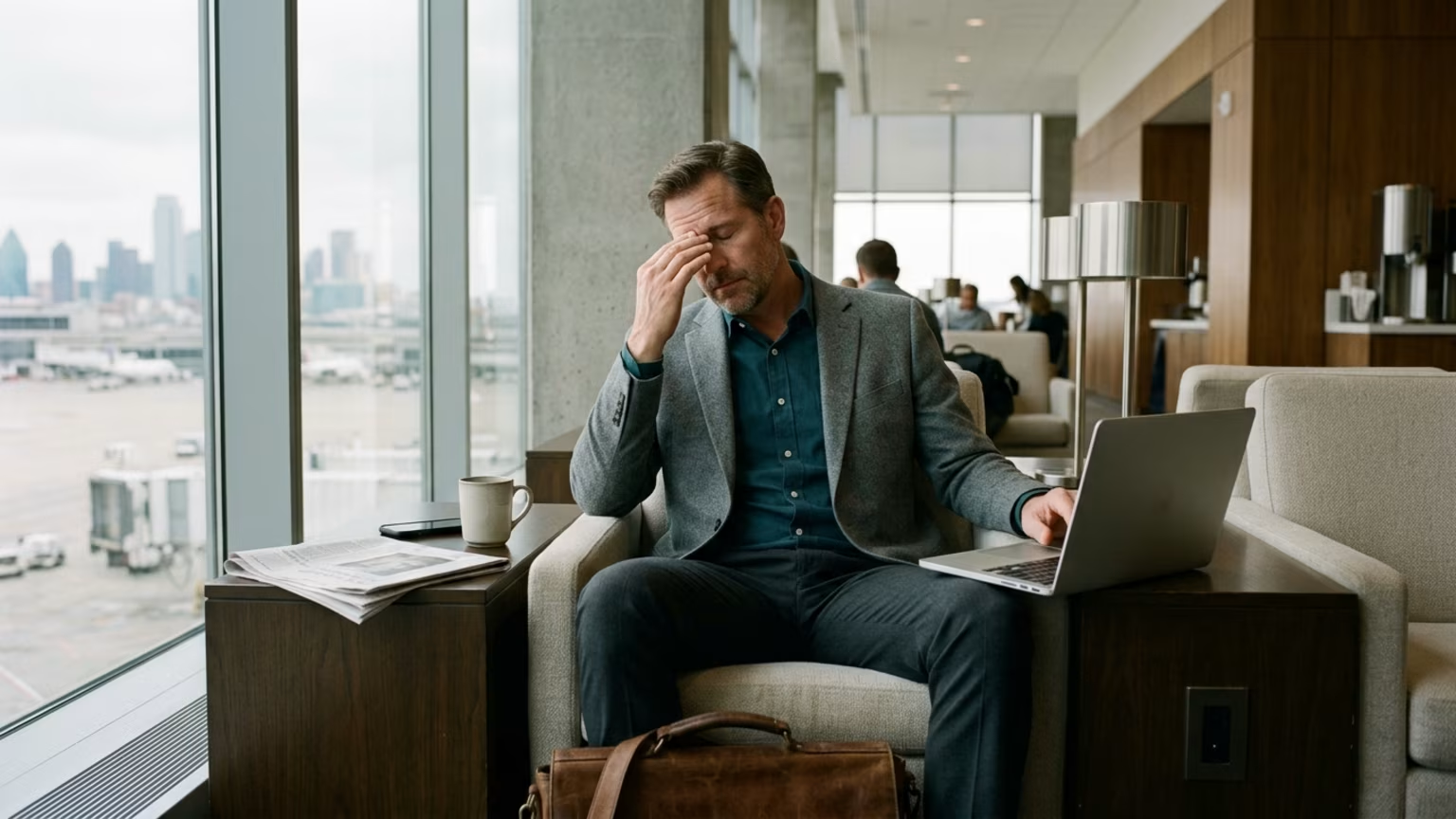

A recent Forbes analysis warns that the always on leadership model creates long term cognitive risks. Read how structural boundaries protect executive health.





On September 14, 2026, Forbes contributor Julian Hayes II published an analysis regarding executive well being. He argued that the perpetual always on leadership model may create a long term brain health liability. This risk specifically impacts executives who combine persistent pressure with disrupted sleep and inadequate recovery. The Forbes analysis frames executive health as an interconnected biological system rather than a matter of mindset alone.
In this system, sleep directly influences how leaders respond to daily stress. Consequently, chronic stress can make it significantly harder to sleep and recover. Forbes describes this dynamic as a potentially self reinforcing cycle. This dangerous cycle allows chronic stress and recurring sleep disruption to persist even while a leader maintains strong external performance. Strong public results simply do not prove that a leader has built a healthy physiological foundation.
The Forbes analysis links its primary argument to a 2026 narrative review published in the journal npj Dementia. This review examined sleep and chronic stress as potentially modifiable factors related to Alzheimer's disease. The Forbes article notes that the review discussed possible effects on inflammation, cellular maintenance, and the clearance of proteins from the brain. These biological maintenance processes require consistent and sufficient rest to function properly.
Forbes highlighted several specific biological mechanisms that operate during rest. One critical process is autophagy, which recycles damaged cellular components to keep tissues healthy. The analysis also points to the glymphatic system, which helps remove waste from the brain during deep sleep phases. According to a 2026 biomedical review, sleep is fundamentally associated with these critical waste clearance mechanisms. This positions rest as a non negotiable biological requirement rather than a lifestyle preference.
The analysis also examines the locus coeruleus. This highly specific brainstem region is involved in attention, memory, stress responses, and sleep wake regulation. Forbes notes that the locus coeruleus is among the areas where tau pathology can emerge. Tau pathology is a biological marker frequently associated with cognitive decline. This overlap suggests that regions managing heavy daily stress also face significant structural vulnerabilities over time.
The central message of the Forbes analysis is highly practical for modern founders. Persistent sleep disturbances and chronic, uncontrolled stress should be treated as operational risks rather than private inconveniences. Leaders must treat recovery as a strategic asset to support their teams effectively. To do this properly, executives must institutionalize boundaries that protect both sleep duration and sleep continuity.
This approach aligns with an earlier Forbes analysis from August 2026. That piece stated that excessive and sustained pressure can impair decision making by destabilizing prefrontal networks. This biological destabilization can contribute directly to impulsivity and scattered priorities. To protect judgment under continuing demands, Forbes recommends implementing structured review processes and leveraging trusted advisers.
This philosophy directly mirrors our own internal testing and editorial standards. As our team often notes, "I spent a week at a popular health optimization conference and left completely exhausted by the complexity. Everyone was pushing a new supplement protocol, a complicated gadget, or a rigid daily routine."
The realization we had was immediate and highly actionable. "It struck me that true high performers do not have time to make health a full time job. They need maximum return on minimum viable effort. That observation became the filter for every piece of research we publish."
Executives need straightforward operational tools to manage these hidden risks. Another Forbes analysis presents the executive calendar as a potentially useful health audit. By examining how time is allocated, leaders can identify recurring demands and habits that silently drain capacity. This supports a managerial approach where proper recovery is designed directly into operating rhythms. You can learn more about managing this tension through our executive performance insights.
The American Academy of Sleep Medicine recommends that adults obtain at least seven hours of sleep per night on a regular basis. That recommendation provides a highly useful benchmark for evaluating busy executive routines. Teams can use this seven hour standard as a baseline against which to assess recurring operational schedules. However, time in bed is only part of the daily performance equation.
A September 2026 consensus summary highlights a critical nuance regarding chronic sleep restriction. The summary reports that repeated nights of restricted sleep can produce accumulating vigilance impairment even when people feel they have become accustomed to the schedule. The direct implication for busy operators is profound. Subjective adaptation to short sleep should never be treated as proof that objective performance has fully recovered.
This is why we focus heavily on practical mitigation instead of chasing perfection. As we often remind our clients, "I remember landing at Heathrow after a brutal overnight flight from New York. I had a board meeting in three hours. The standard advice of getting eight hours of sleep felt like a cruel joke."
The solution requires highly realistic and immediate guidance. "That was the exact moment I realized our readers do not need perfect scenarios. They need triage protocols. They need to know what the science says about recovering cognitive function when you only managed three hours of terrible sleep at high altitude."
This reality confirms why structural support systems are absolutely vital. Leaders facing unavoidable sleep restriction must rely on objective audits and team support to maintain cognitive performance and mental clarity. Relying entirely on a subjective feeling of alertness will inevitably leave teams vulnerable to compounding operational errors.
While the discussion of executive burnout is vital, we must interpret the underlying neuroscience accurately. The Forbes analysis does not establish that the always on leadership model directly causes Alzheimer's disease. The discussion is primarily about plausible biological pathways and potentially modifiable risk factors. It strictly does not map a proven causal chain from executive overwork to dementia.
The article explicitly notes that substantial mechanistic evidence comes from animal and preclinical research. Findings from laboratory models certainly help explain biological processes. However, these animal studies cannot automatically be translated into the exact magnitude of risk faced by human executives. The biomedical review also emphasizes that human waste clearance mechanisms remain mechanistically complex and require extensive further study.
Furthermore, the presence of tau pathology pathways in the locus coeruleus requires careful professional interpretation. This biological overlap does not demonstrate that high pressure work causes neurodegenerative disease in any specific individual. The strongest defensible conclusion is simply that poorly controlled chronic stress is an avoidable exposure. This exposure may slowly undermine cognition and long term health if left unmanaged.
Finally, daily sleep disruption is certainly not specific to leadership culture. Medical conditions, caregiving duties, frequent travel, and sleep apnea can all heavily influence sleep quality. Addressing executive health requires looking at these broader life factors alongside traditional workplace demands. You can read more about evaluating these holistic factors in our sleep and recovery research.
Looking ahead, the intersection of behavioral neuroscience and leadership strategy will likely become much more rigorous. We expect future clinical studies to focus heavily on translating preclinical waste clearance models into practical human applications. As research clarifies how the human glymphatic system responds to behavioral stress, executive health guidelines will become significantly more precise.
Until those long term studies conclude, the broader business community must rethink how it measures operational resilience. We anticipate that more corporate boards will begin treating persistent sleep disruption as a highly measurable risk. Protecting leadership capacity will require shifting focus away from individual endurance and toward robust structural boundaries.
The most successful organizations will be those that integrate systemic recovery into their core operating models. By replacing the expectation of perpetual availability with disciplined operational rhythms, leaders can actively protect their long term cognition. Building these reliable structures today is the most effective way to ensure sustainable healthy aging and executive longevity tomorrow.
Stay connected for research and practical guidance on executive performance, energy, focus, sleep, recovery and longevity. Ideas built for people who want to stay sharp, capable and effective for the long run.





Build habits and systems that support clear thinking, steady energy and long term capacity throughout a demanding career.
explore the Blog