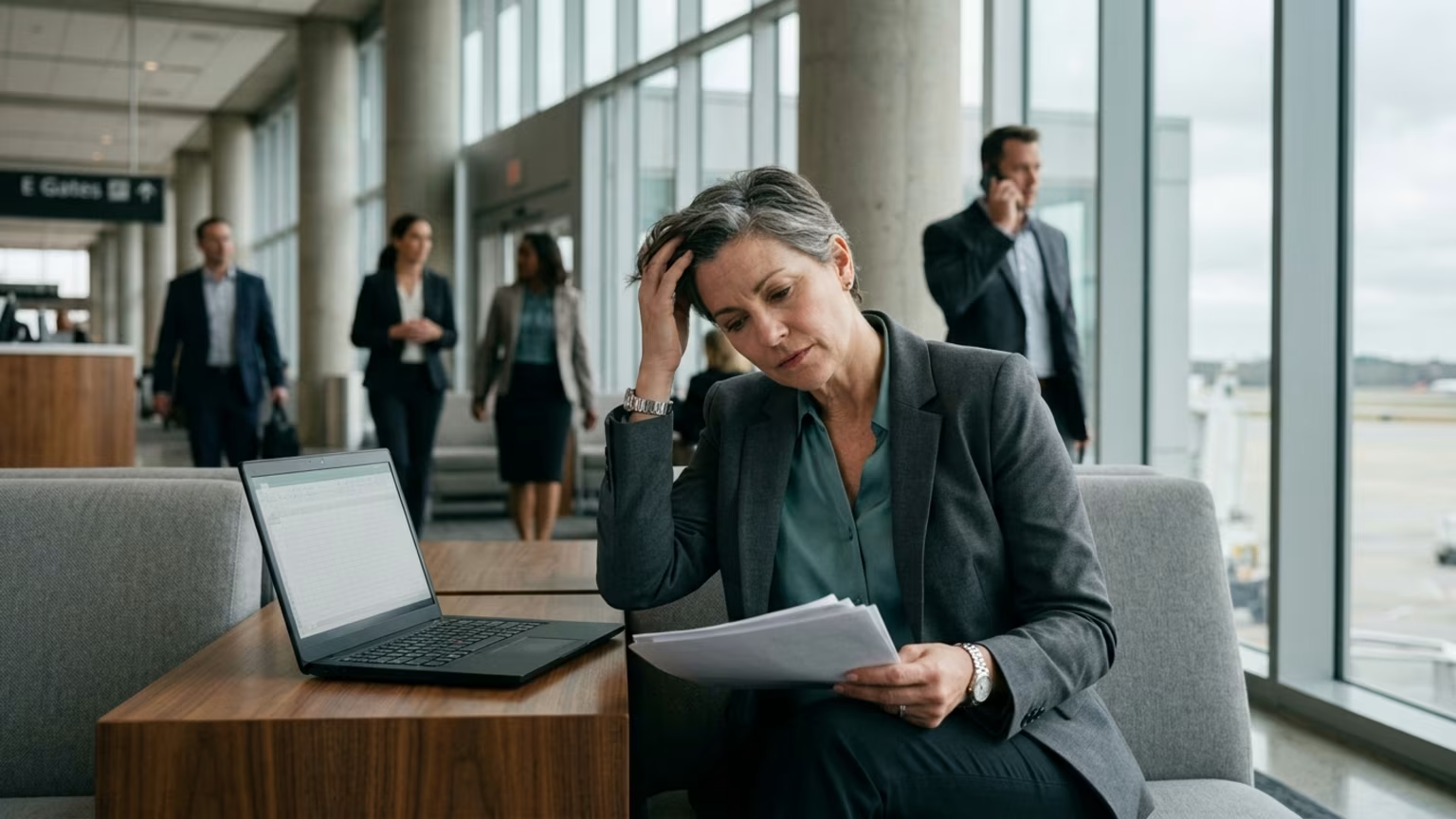

A 2026 survey reveals that 79.1% of executives report sleep concerns, highlighting how poor recovery impacts workplace evaluations and leadership capabilities.





On March 25, 2026, Tokyo-based wellbeing company ECOTONE published findings on executive sleep patterns and their association with organizational environments. The internet survey gathered responses from 515 employed leaders in Japan. The headline finding revealed that 79.1% of respondents reported some kind of sleep-related concern. Conversely, only 20.9% of those surveyed reported no particular sleep issues.
This survey places executive recovery firmly in the spotlight as a business metric. The research focused on how leaders rest and how they view their own companies. It avoids exaggerated claims about sleep curing all business problems. Instead, it provides a grounded look at how physical exhaustion correlates with leadership satisfaction.
ECOTONE conducted its survey among men and women aged 20 to 69. All participants identified as executives at large, mid-sized, or small and medium-sized companies. The researchers weighted the overall results by company-size composition. This weighting meant small and medium-sized-company executives represented 99.7% of the reported population.
The survey assessed sleep satisfaction using a five-point scale. It measured ideal versus actual sleep duration to identify recovery deficits. Through open-ended responses, the researchers gathered qualitative data on specific sleep problems. Analysts then categorized these responses to identify patterns in executive fatigue.
Beyond individual sleep metrics, the researchers utilized a “Well-Being Management Diagnosis” framework. This tool assessed 15 different workplace-environment items. Participants rated their companies on factors like internal transparency, shared vision, and physical comfort. The methodology aimed to bridge the gap between a leader's physical recovery and their perception of the workplace.
ECOTONE itself was established in October 2024. The company operates across wellbeing media, incubation, community, and consulting activities. The release of this survey was intentionally timed around Japan’s September 3 Autumn Sleep Day. This timing situates the findings within a broader national conversation regarding workforce productivity.
The findings underscore the reality of demanding professional lives. ECOTONE representative director Ken Dojo argues that executives must prioritize their own recovery before building healthier organizations. He links executive sleep directly to decision-making, people management, and operational capacity. Leaders often remain mentally engaged with unfinished work long after leaving the office.
In the survey, 94 executives specifically mentioned difficulty falling asleep or a persistently activated mind. Another 43 leaders cited stress or anticipatory anxiety as barriers to rest. Dojo also described a five-day personal experiment involving sleep-brainwave measurement to track his own habits. He noted this helped reveal sleep issues that were not obvious from subjective impressions alone.
Founders and senior operators cannot treat sleep merely as a personal preference. Poor recovery directly impacts sustained capacity, making it a central factor in Energy & Productivity. A separate 2026 analysis by Nomura Research Institute examines excessive daytime sleepiness as a distinct productivity issue. This analysis argues that sleep risk cannot be understood solely by counting the hours spent in bed.
Executives can meet a nominal sleep target and still experience poor restoration. Reduced cognitive continuity and daytime sleepiness threaten decision quality. Establishing a dedicated Sleep Optimization & Recovery routine is essential for long-term endurance. Leaders who struggle to switch off after work may create an implicit expectation for their teams.
Employees often take an executive’s working patterns as a signal about what the organization values. Late-night messages and weekend escalations implicitly discourage rest. Founders must examine whether their own habits are undermining their organizational goals.
The survey data revealed a stark divide between rested and fatigued leaders. Only 44.7% of executives were classified as sleep-satisfied. This group comprised 13.6% who were very satisfied and 31.1% who were somewhat satisfied. Meanwhile, 32.6% fell into the dissatisfied group, and 22.8% selected the neutral category.
The largest practical gap between these groups was their actual sleep duration. Both satisfied and dissatisfied executives reported an ideal sleep duration of 7.3 hours. However, the sleep-satisfied group reported 6.8 hours of actual sleep. The dissatisfied group managed only 5.1 hours. Across all executives, the average actual sleep was 6.2 hours, creating a reported shortfall of 1.1 hours.
Quality of rest also varied dramatically. Shallow or non-restorative sleep affected 55.2% of the dissatisfied group, compared to just 4.4% of the satisfied group. This represents a massive 50.8-percentage-point difference. Nighttime awakening was reported by 41.8% of dissatisfied leaders and 14.1% of satisfied leaders. Furthermore, 32.9% of the dissatisfied group felt tired despite sleeping, versus 4.4% of the satisfied cohort.
These physical deficits correlated strongly with workplace perceptions. The share reporting high happiness was 68.5% among sleep-satisfied executives compared with 37.4% among dissatisfied executives. For a metric called "Well-Working," the satisfied group scored 55.5% against the dissatisfied group's 21.0%. ECOTONE reports that dissatisfied executives scored lower on all 15 workplace-environment items.
Specific workplace evaluations highlighted the divide in organizational perception. Among satisfied executives, 57.6% said employees enjoyed good interpersonal relationships and could volunteer for desired work. Only 28.4% of dissatisfied leaders agreed. Satisfied leaders also reported higher workplace transparency, with 69.6% stating internal decisions were open, compared to 43.3% of dissatisfied executives.
The survey also utilized a measure called the "Well-Working Gap." This metric compares what prospective job changers want in a workplace with what executives believe their own companies provide. The average gap was 10.7 percentage points among sleep-satisfied executives and 33.7 points among dissatisfied executives. ECOTONE describes the latter gap as approximately three times larger.
Despite these clear gaps, meaningful action remains limited. Among the 409 executives who reported some sleep concern, 49.7% were taking some action to improve their sleep. However, only 19.0% maintained a daily effort. Large-company executives with sleep concerns took slightly more action, with 28.6% reporting a daily routine.
This data indicates that maintaining Executive Performance requires consistent, daily structural habits. Short-term interventions are insufficient for demanding roles. Building a reliable structure around recovery is mandatory for sustained leadership.
This survey provides valuable insights but comes with distinct limitations. It is an internet survey rather than a clinical sleep study. The results rely entirely on self-reporting for sleep duration, happiness, and workplace quality. These metrics do not represent objective physiological data or independently verified organizational performance.
The weighting of the data requires careful consideration. Because small and medium-sized-company executives represented 99.7% of the weighted population, the headline findings do not equally represent major corporations. Furthermore, the 79.1% figure represents respondents reporting some kind of sleep concern. It does not mean that nearly four in five executives have a diagnosed sleep disorder or clinical insomnia.
Crucially, the findings are correlational rather than causal. ECOTONE does not claim that the survey proves sleep satisfaction directly causes better workplace conditions. Common factors like financial stress, workload, or company performance could influence both sleep and workplace evaluations. The open-ended responses were also analyst-classified, meaning they only capture problems respondents recalled and described.
Finally, the comparisons between satisfied and dissatisfied groups exclude the 22.8% of respondents who selected the neutral answer. These comparisons do not describe every executive in the survey. The data provides a useful snapshot, but it should not be treated as a definitive blueprint for all organizational types.
The conversation around executive recovery is maturing past simple duration metrics. The Nomura Research Institute analysis points toward a sharper focus on daytime alertness and cognitive continuity. Future research will likely isolate the economic costs of impaired decision-making rather than just tracking hours in bed. This shift will require more sophisticated measurement tools.
Organizations are beginning to view recovery as a structural issue rather than an individual failing. Workload predictability, decision clarity, and communication norms play significant roles in how leaders rest. Expect to see more companies integrating non-punitive, aggregated pulse data to monitor organizational fatigue. This approach protects sensitive health information while identifying systemic stress points.
The survey clearly identifies difficulty falling asleep, racing thoughts, and non-restorative sleep as recurring concerns among executives. Persistent or severe symptoms warrant evaluation by a qualified healthcare professional rather than relying solely on consumer trackers. Proper clinical support is a more effective investment than superficial productivity routines when facing chronic exhaustion.
For founders and operators, the path forward involves deliberate separation of work and rest. Leaders must evaluate their own habits to ensure they are not modeling exhaustion as a virtue. The science clearly suggests that sustained leadership requires intentional recovery, clear operational boundaries, and a commitment to long-term physical readiness.
Stay connected for research and practical guidance on executive performance, energy, focus, sleep, recovery and longevity. Ideas built for people who want to stay sharp, capable and effective for the long run.




Build habits and systems that support clear thinking, steady energy and long term capacity throughout a demanding career.
explore the Blog