
A new Cureus review finds tDCS and CES offer subjective sleep benefits but lack consistent objective evidence. Read the implications for executive recovery.





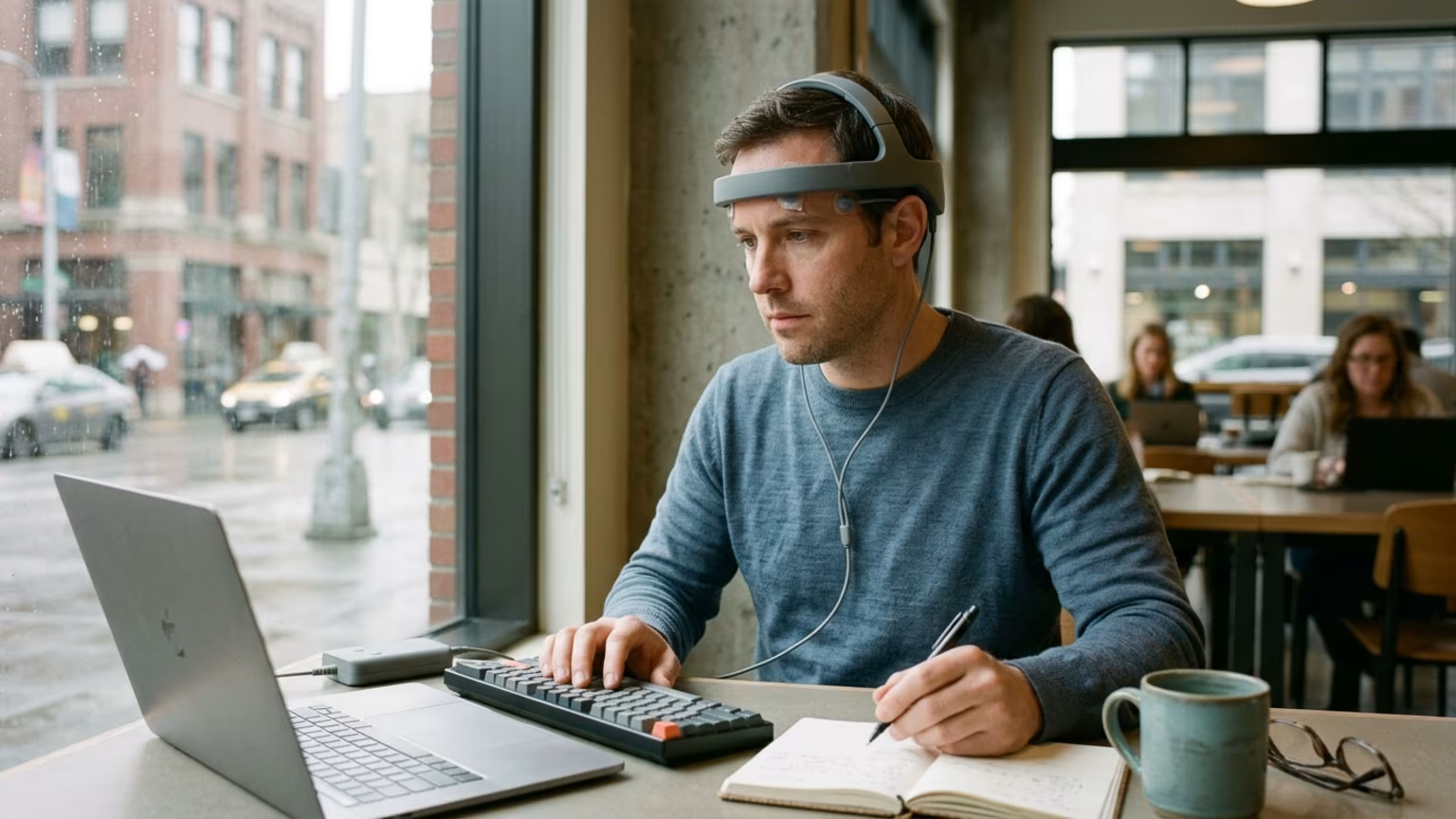
On September 18, 2026, a narrative review published in Cureus examined transcranial direct current stimulation (tDCS) and cranial electrotherapy stimulation (CES) as tools for athletic performance and sleep. The findings present a measured reality check for an increasingly popular category of recovery hardware. The review found that tDCS might improve subjectively reported total sleep time and perceived sleep quality. However, randomized athlete data did not demonstrate consistent objective improvement in polysomnography or measurable sleep depth. For performance focused professionals, this suggests non-invasive neuromodulation remains an experimental adjunct rather than a definitive clinical intervention.
The researchers conducted a comprehensive search of major medical databases to isolate the most relevant trials. They identified 781 records and assessed 72 articles in full text format. After conducting strict citation tracking and relevance screening, the authors synthesized 39 publications. This rigorous filtering allowed the researchers to focus on the specific impacts of electrical stimulation on recovery and function.
The primary evidence for tDCS and sleep relied heavily on a randomized sham controlled study of 30 student athletes. This specific trial split the participants into two equal groups of 15 individuals. Participants completed an initial adaptation night in the laboratory to acclimate to the environment. They then recorded two baseline polysomnography nights to establish their normal sleep architecture.
Finally, the subjects completed two nights after receiving bifrontal tDCS for 20 minutes. This stimulation was administered 90 minutes before bedtime. The active stimulation protocol utilized a modest 2 mA of current.
The CES evidence evaluated in the review was somewhat more encouraging but remained entirely preliminary. The review described the CES athlete evidence as consisting of small studies with varied structural limitations. One trial proceeded without a sham condition, while another operated without a no treatment control group.
One specific CES study observed 25 professional athletes who suffered from poor sleep quality. In this trial, 12 participants received CES treatment while 13 served as controls. A second notable trial involved 24 combat sport athletes dealing with poor pre-competition sleep quality. This second study compared four weeks of CES directly against cognitive behavioral therapy for insomnia.
A final randomized trial studied 40 sport university athletes. This trial tracked sleep efficiency measured by actigraphy as competition approached. It found that CES attenuated the decline in sleep efficiency, but the intervention did not improve the metric above baseline.
The findings highlight a distinct gap between how users feel and what objective equipment records. In the tDCS trial, sleep diaries suggested a marginal increase in subjective total sleep time. The active group also showed score improvements from baseline on the Pittsburgh Sleep Quality Index and the Insomnia Severity Index. However, the study found no significant between-group improvement in conventional polysomnographic sleep measures.
The tDCS trial also failed to demonstrate any improvement in overall odds ratio product sleep depth outcomes. The smaller CES trials revealed different patterns of data. In the study of 25 professional athletes, CES was associated with lower wake after sleep onset measured by actigraphy. It also correlated with higher objective sleep efficiency, but the total sleep time did not change significantly.
Subjective sleep quality improved in both the active and control groups during this trial. Because the study lacked a sham condition, expectation effects could not be excluded from the final results. The comparative study between CES and cognitive behavioral therapy provided crucial context. Subjective sleep quality and daytime sleepiness improved in both the CES and therapy groups.
However, objective sleep efficiency increased significantly only after the behavioral therapy intervention. The CES group did show a structural shift toward a greater proportion of deep sleep and a lower proportion of light sleep. The researchers also noted changes in nocturnal heart rate variability for the stimulated group. The absence of a no treatment control meant placebo effects could not be ruled out entirely.
The review also detailed possible athletic performance effects from tDCS across various physical tasks. One meta-analysis summarized in the review evaluated acute anodal tDCS across multiple sports. This analysis found a moderate pooled effect, recording a standardized mean difference of 0.39 with a 95 percent confidence interval of 0.23 to 0.54. Another meta-analysis encompassing 40 studies and 778 participants found a small overall effect across muscular endurance, cardiopulmonary endurance, and static balance.
Founders and operators constantly search for tools that promise rapid recovery and sharper thinking. I spent a week at a popular health conference and left completely exhausted by the complexity. Everyone was pushing a new supplement protocol, a complicated gadget, or a rigid daily routine. It struck me that true high performers do not have time to make health a full time job.
They need maximum return on minimum viable effort. That observation became the filter for every piece of research we publish at ExecuFuel. This precise tension applies to the commercial positioning of transcranial stimulation. Vendors frequently position these tools around focus, stress regulation, and physical resilience.
However, the commercial appeal often outpaces the strict clinical evidence. The Cureus review does not establish that benefits observed in endurance athletes transfer reliably to operators managing complex corporate negotiations. Devices that provide minor gains in physical tests do not inherently protect long term cognitive capacity in a boardroom. Subjective improvements are still valuable in a high stakes environment.
Perceived sleep quality and reduced daytime sleepiness directly impact how an executive manages stress. Feeling rested can provide the necessary momentum to maintain consistent energy for demanding work schedules. Yet, subjective improvement does not demonstrate deeper sleep, improved sleep architecture, or the correction of an underlying physiological disorder. Professionals must prioritize proper medical diagnosis before relying on consumer hardware.
A stimulation device should never bypass evaluation for chronic insomnia, sleep apnea, circadian disruption, or severe overtraining. The review authors specifically position neuromodulation as a complement to established insomnia interventions. They do not view it as a primary replacement for proven clinical care. The clinical guidelines for chronic insomnia strongly support behavioral interventions over experimental hardware.
The American Academy of Sleep Medicine gives a strong recommendation to multicomponent cognitive behavioral therapy for insomnia. Recommendations for individual components such as stimulus control, sleep restriction, and relaxation remain conditional. The same guideline summary indicates that basic sleep hygiene alone is not an adequate substitute for comprehensive behavioral treatment. This distinction matters deeply for leaders attempting to resolve severe fatigue.
The current evidence base for both technologies remains methodologically fragile. Individual trials generally relied on very limited numbers, with sample sizes ranging from just 12 to 40 participants. Small cohorts severely increase the uncertainty around effect-size estimates. They also leave the studies highly susceptible to selection bias and statistical noise.
Consequently, the review explicitly identified an elevated risk of bias across the included literature. Blinding presents a significant and persistent hurdle for tDCS trials. Active stimulation can produce distinctly perceptible physical sensations. Participants frequently report feeling tingling, itching, skin redness, or mild headaches during the active application.
When participants can feel the intervention, true double blinding becomes nearly impossible. CES studies encounter a different but equally problematic structural limitation. Without rigorous sham or no treatment controls, researchers cannot isolate the exact mechanism of improvement. Favorable outcomes might reflect the simple expectation of treatment, natural fluctuations in sleep cycles, or changes in training intensity.
Furthermore, results from one specific hardware protocol cannot be automatically generalized to another. The review noted that tDCS protocols differed radically across multiple variables. Studies utilized different electrode montages, current intensities, and anatomical targets. They also varied significantly in application durations and timing schedules.
Safety data in athletic populations remain scarce and require systematic collection. This holds true even though low intensity applications are generally considered well tolerated. Finally, the Cureus publication is a narrative review rather than a formal systematic review. This classification leaves some potential for publication selection bias by the authors.
The current landscape requires a highly disciplined approach to new recovery technology. Moving forward, the scientific community must conduct larger, fully randomized trials with standardized protocols. Researchers need to clearly separate subjective feeling from objective physiological markers. Until those trials arrive, both tDCS and CES will remain specialized research tools rather than standard clinical interventions.
Corporate wellness programs and human performance teams should demand absolute protocol transparency. Any workplace pilot exploring these tools must document the specific stimulation target, current, duration, and sham design. A credible program requires prearranged outcomes and enough follow up tracking to distinguish a genuine treatment effect from mere novelty. Business relevant outcomes could include validated insomnia scores, recorded attendance, and structured cognitive performance tests.
The ethical and practical questions surrounding cognitive enhancement will continue to grow. The review highlights concerns about unequal access to specialized equipment, the requirement for expert supervision, and the use of patented commercial protocols. There is also no readily detectable biological marker to confirm whether an individual has used these devices. Ambitious professionals should monitor these developments calmly while anchoring their recovery entirely in proven behavioral strategies.
Stay connected for research and practical guidance on executive performance, energy, focus, sleep, recovery and longevity. Ideas built for people who want to stay sharp, capable and effective for the long run.


Build habits and systems that support clear thinking, steady energy and long term capacity throughout a demanding career.
explore the Blog