
Frequent travel disrupts biological rhythms, making portable sleep protocols, circadian light timing, and modular environmental controls essential.





A portable sleep system is not a luxury travel kit, nor is it an attempt to replicate every comfort of a master bedroom in a hotel suite. It is an operational framework. It is a systematic collection of environmental controls, biological cues, behavioral sequences, and decision rules designed to protect human recovery across variable environments.
Whether you are navigating a multi-city roadshow, managing properties across two continents, or sleeping in an airport hotel between board meetings, your biology remains indifferent to your schedule. High-performing professionals often view sleep disruption as an inevitable tax on ambition. That assumption is both incorrect and costly.
By standardizing the primary variables that govern sleep architecture, you can achieve reliable physical and cognitive restoration in virtually any room. The guide below breaks down the physiology of portable recovery, provides a tested implementation framework, and outlines the operating protocols needed to perform when conditions are far from ideal.
For time-pressed operators, building an effective mobile sleep setup comes down to controlling key biological variables rather than carrying excessive equipment. The core principles of portable recovery include:
Human recovery depends on two primary biological engines: the homeostatic sleep drive and the circadian timing system. Understanding how these systems respond to environmental volatility is the first step in building a resilient travel framework.
Sleep opportunity is defined as the total time dedicated to rest in an environment conducive to sleep. It is distinct from total sleep time. If an executive allocates six hours in bed, normal sleep latency and brief nighttime awakenings will inevitably reduce actual sleep to five hours or less. The Centers for Disease Control and Prevention and major sleep medicine societies recommend at least seven hours of sleep per night for adults aged 18 to 60 to maintain health and baseline cognitive function.
Sleep regularity measures the day-to-day consistency of sleep and wake timing. Large-scale observational analyses demonstrate that high sleep regularity is strongly associated with lower all-cause mortality risk. In these cohorts, individuals with the most regular sleep patterns showed a 20% to 48% reduction in all-cause mortality and cardiometabolic mortality compared to those with irregular schedules. Regularity supports cardiovascular health, metabolic function, and sustained attention during demanding professional workloads.
The central circadian clock, located in the suprachiasmatic nucleus of the brain, synchronizes internal physiology with external time. Light is the primary zeitgeber, or time cue, that resets this clock each day.
The biological impact of light depends strictly on the timing of exposure relative to your core body temperature minimum. Laboratory research simulating time advances shows that appropriately timed room light can shift core temperature rhythms by more than five hours within a single cycle. Conversely, exposure to light at an inappropriate circadian phase can stall adaptation or shift the body clock in the opposite direction.
For travelers, light is an active tool. Morning light promotes an advance in circadian phase, making it easier to fall asleep earlier the following night. Late-evening light produces a phase delay, pushing the natural sleep window later into the night.
Homeostatic sleep pressure accumulates as adenosine builds up in the basal forebrain during continuous wakefulness. This biochemical pressure dissipates almost exclusively during consolidated sleep.
When travelers spend long periods lying awake in bed trying to force sleep, they decouple the neurological association between the bed and rest. Clinical frameworks for insomnia, such as stimulus-control therapy, demonstrate that remaining awake in bed during acute stress creates conditioned arousal. If the brain learns that the bed is a place for problem-solving, anxiety, or work, sleep onset latency expands significantly. Preserving clear behavioral boundaries around the bed protects the homeostatic trigger.
Acoustic disruption is a primary cause of sleep fragmentation in unfamiliar environments. Research compiled by the World Health Organization indicates that continuous nocturnal noise above 30 decibels inside a bedroom can disrupt deep sleep architecture. Outside noise levels above 40 decibels are consistently associated with adverse health outcomes and sleep disturbance.
Systematic reviews examining transportation and hotel noise demonstrate that every 10-decibel increase in peak indoor sound significantly raises the odds of waking up. Intermittent noises, such as elevator chimes, slamming doors, or street traffic, are far more disruptive to sleep maintenance than steady background sound. Masking these peaks with continuous low-frequency sound prevents micro-arousals that degrade sleep quality.
Caffeine operates by blocking adenosine receptors in the brain, masking biological fatigue without clearing the underlying sleep debt. Controlled research demonstrates that a standard dose of caffeine consumed even six hours before bedtime causes measurable reductions in total sleep time and slow-wave sleep depth.
Because the metabolic half-life of caffeine ranges between four and seven hours depending on individual hepatic clearance rates, afternoon consumption directly impairs sleep continuity. In unfamiliar environments where sleep quality is already vulnerable, unmonitored caffeine use compounds recovery failure.
Standard wellness guidance typically relies on fixed, comfortable assumptions. It advises busy professionals to sleep eight hours in a silent room, take an hour-long hot bath, and disconnect from all digital screens by 8:00 PM. For an executive closing an acquisition across three jurisdictions, this advice is completely detached from reality.
I remember landing at Heathrow after a brutal overnight flight from New York. I had a board meeting in three hours. The standard advice of getting eight hours of sleep felt like a cruel joke. That was the exact moment I realized our readers do not need perfect scenarios. They need triage protocols. They need to know what the science says about recovering cognitive function when you only managed three hours of terrible sleep at high altitude.
Demanding careers involve unpredictable arrivals, high-stakes negotiations, urgent international communications, and variable accommodations. When unexpected friction occurs, generic advice collapses because it offers no backup plan for compromised conditions.
When your baseline schedule is disrupted, you cannot rely on ideal routines. You need a system that functions despite tight deadlines, noisy hotel corridors, and sudden schedule changes. Executives require operational resilience, applying structured advanced sleep and recovery frameworks that deliver measurable recovery under real-world pressure.
Under intense cognitive load, maintaining clarity is non-negotiable. Poor sleep impairs prefrontal cortex function, reducing executive control, risk assessment, and emotional regulation. Standardizing your recovery behaviors ensures that even when your sleep duration is restricted, your physiological baseline remains stable enough to protect executive cognitive performance throughout the business day.
A reliable sleep system is structured as a clear hierarchy. When you travel, you do not need to bring your entire home bedroom with you. You only need to secure four distinct operational tiers: Anchor, Environment, Sequence, and Recovery.
The anchor is the fixed biological reference point that stabilizes your schedule.
The sleep space must be controlled for light, sound, and temperature.
The wind-down sequence is a portable behavioral script that triggers conditioned relaxation.
Recovery rules govern how you respond when a night is compromised by transit delays or urgent demands.
An effective kit is organized into a modular pouch that stays inside your primary travel bag. It eliminates the friction of searching for gear late at night.
When you arrive in any room, execute the two-minute deployment sequence immediately:
Different operational environments introduce specific points of friction. Managing them requires targeted operating procedures rather than improvised responses.
Professionals who divide their time between multiple homes often experience subtle sleep disruption. While the environments may be comfortable, subtle differences in lighting, mattress firmness, and ambient noise can disrupt sleep continuity.
Hotels present unpredictable challenges, including thin walls, bright electronic indicator lights, and early morning housekeeping activity.
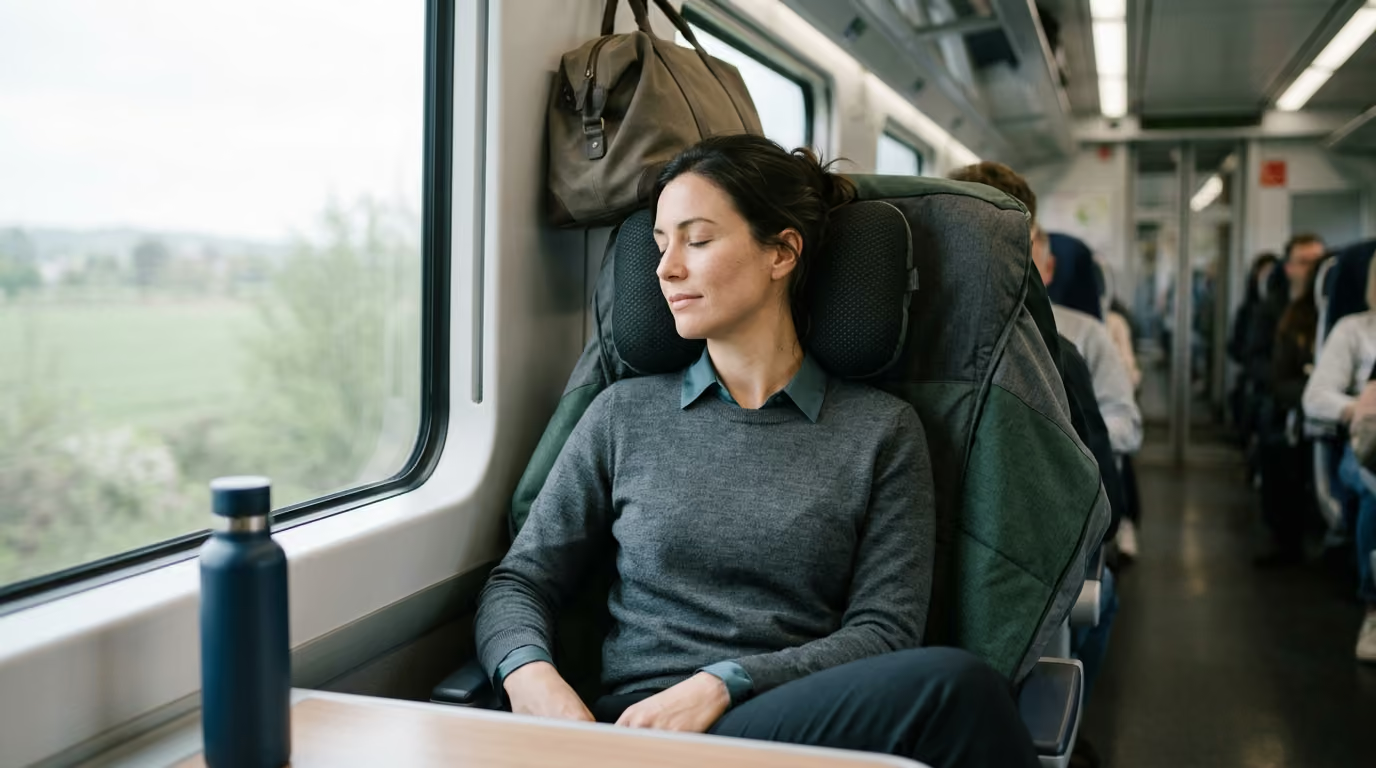
Sleeping in airports, trains, executive lounges, or dedicated corporate rest facilities requires a balance between rest and personal situational awareness.
Crossing multiple time zones creates an immediate mismatch between your internal circadian rhythm and local environmental time. Solving this challenge requires precise physiological inputs rather than random supplement use.
The direction of travel dictates how you must adjust your circadian clock. Traveling east requires advancing your body clock to an earlier time, which is generally more difficult than delaying it during westward travel.
Melatonin is a chronobiotic hormone that signals the biological onset of darkness to the body clock. It is a timing tool, not a powerful sedative.
Systematic Cochrane reviews demonstrate that appropriately timed melatonin helps reduce jet lag for adults crossing five or more time zones, particularly during eastward travel. When crossing multiple time zones, a low dose taken near the destination bedtime for two to four days helps align your internal clock with the new schedule.
Melatonin should always be used with clinical care. Keep dosages low, verify the quality of your source, and consult a qualified physician to ensure it does not interact with other medications.
Caffeine and alcohol are frequently misused during executive travel. Using stimulants to force daytime alertness and alcohol to induce nighttime sleep creates a severe cycle of sleep fragmentation.
Laptops, tablets, and smartphones impair sleep in two distinct ways: through blue-enriched light emission that suppresses melatonin and through active psychological stimulation.
While an engineered sleep system improves recovery across variable environments, you must recognize the clear boundaries of behavioral and environmental interventions.
Portable sleep frameworks are designed to manage acute environmental friction, schedule variability, and short-term travel demands. They cannot cure chronic clinical sleep disorders.
When a night goes poorly, professionals often make common mistakes that prolong their sleep issues:
To maintain sustainable long-term output, leaders must pair their recovery habits with broader strategies for building stress resilience under high workloads, addressing both physical recovery and physiological load.
When schedules are severely compressed, such as during back-to-back quarterly reviews or international flight delays, standard routines must scale down to core triage actions.
If unexpected delays reduce your available sleep opportunity to four hours, abandon complex evening routines and execute a focused triage plan:
To keep your sleep system reliable across changing schedules, audit your setup every three months. Review our comprehensive performance and health resource library to refine your personal operating procedures.
Keep a simple two-week travel log tracking your sleep windows, wake times, caffeine cutoffs, and daytime focus. If you find yourself consistently improvising in hotel rooms or struggling with afternoon brain fog, look for gaps in your environmental kit or morning light habits.
Consistently applying these fundamentals protects your health and cognitive clarity. You do not need ideal circumstances to achieve deep recovery. By building a disciplined, repeatable system, you can protect your sleep architecture and perform at your highest level in any environment worldwide.
Ear canal anatomy varies widely. Standard high-decibel foam earplugs often exert excessive lateral pressure on smaller ear canals, causing discomfort that leads to awakenings.
Try using moldable silicone or soft wax earplugs that seal the outer opening of the ear canal without expanding inside it. Alternatively, slim-profile polyurethane plugs designed for smaller canals provide sound attenuation without painful pressure. If physical plugs remain uncomfortable, pair a travel white-noise machine with a soft, padded headband that contains flat, integrated speakers.
Waking up in the middle of the night is a common symptom of circadian misalignment or acute stress. If you wake up and cannot fall back asleep after approximately 20 minutes, do not stay in bed tossing and turning.
Get out of bed, sit in an armchair under dim, warm lighting, and read a physical book or complete a brief breathing exercise. Do not check work email, open financial dashboards, or look at the clock. Return to bed only when physical drowsiness returns. This stimulus-control technique keeps your brain from associating the bed with frustration and wakefulness.
Shared rooms require clear upfront communication about light and sound expectations.
Agree on a firm lights-out time early in the evening. Keep your smartphone, alarms, and notifications on silent or vibrate-only modes. Use a contoured blackout eye mask and high-grade earplugs to create an isolated personal sleep environment that operates independently of your colleague's habits. If you need to work late, move to the hotel business center or lobby rather than working on a laptop inside the shared room.
If a hotel thermostat is locked at an uncomfortable temperature, contact the front desk immediately and ask maintenance to adjust the central settings or provide a portable fan.
To manage dry air from continuous commercial HVAC systems, place a damp bath towel over the luggage rack or near the air output vent to introduce moisture into the immediate sleeping area. You can also run a hot shower for five minutes with the bathroom door open before starting your wind-down routine to increase ambient humidity.
Stay connected for research and practical guidance on executive performance, energy, focus, sleep, recovery and longevity. Ideas built for people who want to stay sharp, capable and effective for the long run.


Build habits and systems that support clear thinking, steady energy and long term capacity throughout a demanding career.
explore the Blog