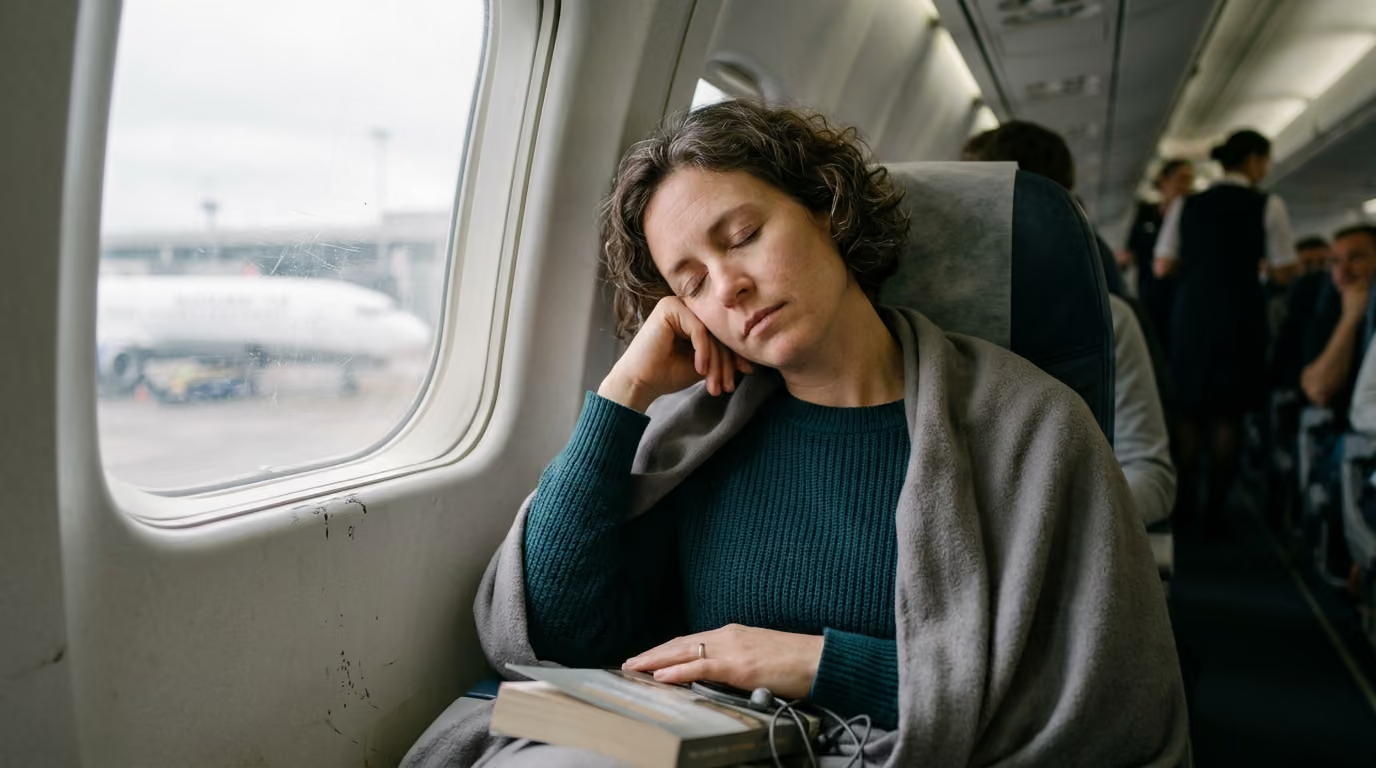

Evidence-based research clarifies the biological facts behind sleep duration, nighttime light exposure, and everyday rest tracking.





Most popular sleep advice treats human biology as fragile and arithmetic. We are told that missing an hour of rest causes immediate cellular catastrophe, that precisely eight hours is mandatory for every adult, and that any evening screen exposure ruins restorative sleep.
This rigid framing creates unnecessary anxiety. In clinical and high-performance environments, perfectionistic beliefs about sleep often cause the exact insomnia and stress they seek to prevent. A rigorous understanding of sleep physiology shows that our recovery systems are remarkably adaptable, nuanced, and resilient.
This reference guide examines the most persistent sleep myths through peer-reviewed research. It replaces broad assertions with precise data, helping you build a sustainable approach to rest and recovery.
Popular discussions frequently reduce sleep to a single number on a digital dashboard. In physiological research, sleep is not a monolithic block of unconsciousness. It is an active, multi-phase biological state that interacts continuously with your metabolic, endocrine, and neurological systems.
To evaluate rest accurately, clinicians assess five distinct dimensions rather than relying solely on duration. When you evaluate your rest through these specific parameters, you can identify performance bottlenecks without falling into rigid assumptions.
Sleep duration refers strictly to total physiological sleep time, not total time spent lying in bed. The American Academy of Sleep Medicine and the Sleep Research Society recommend at least seven hours per night for healthy adults.
Individual requirements vary across populations based on genetic factors, training volume, and immune activity. A baseline duration of 7.2 hours may fully restore one executive, while a colleague requires 8.5 hours to maintain equivalent cognitive performance.
Sleep quality describes the continuity, efficiency, and structural progression of sleep cycles. Normal sleep architecture moves through distinct non-rapid-eye-movement stages into rapid-eye-movement sleep roughly every 90 to 110 minutes.
Deep slow-wave sleep dominates the initial third of the night, supporting tissue repair and physical recovery. Rapid-eye-movement sleep expands during the final third, playing a vital role in emotional regulation, memory consolidation, and executive decision-making.
Sleep timing reflects when rest occurs relative to your internal 24-hour circadian pacemaker. The suprachiasmatic nucleus in the hypothalamus coordinates physiological processes based on environmental light and dark cycles.
Sleeping for eight hours during biological daytime produces substantially different hormonal and neurological outcomes than sleeping eight hours at night. Circadian misalignment degrades sleep efficiency, alters glucose tolerance, and impairs daytime alertness.
Sleep regularity measures the consistency of your sleep and wake boundaries across consecutive days. High day-to-day variability creates internal circadian friction, even if weekly duration totals appear adequate.
Research indicates that irregular sleep schedules destabilize daytime energy and impair metabolic health. Maintaining consistent wake times supports circadian synchronization more effectively than varying your schedule by several hours each week.
Daytime cognitive and physical performance remains the ultimate benchmark of sleep adequacy. A wearable device may report an unfavorable sleep score, but sustained daytime vigilance, emotional stability, and clear executive function indicate biological sufficiency.
Conversely, achieving eight hours in bed while experiencing persistent brain fog and heavy daytime sleepiness signals potential sleep fragmentation or an underlying sleep disorder. Daytime capacity provides the reality check that digital algorithms cannot measure.
Understanding these dimensions helps you navigate our extensive sleep and recovery resources with a critical, scientific mindset.
The belief that every human being requires exactly eight hours of nightly sleep is one of the most widespread health dogmas. While eight hours represents a reasonable midpoint for population averages, setting it as a universal requirement is scientifically inaccurate.
The joint consensus statement from the American Academy of Sleep Medicine and Sleep Research Society established that adults should sleep seven or more hours per night regularly to promote optimal health. The panel identified seven to nine hours as appropriate for healthy adults, explicitly rejecting the idea of a rigid eight-hour mandate.
Large-scale epidemiological studies frequently demonstrate a U-shaped or curved association between sleep duration and all-cause mortality. The lowest statistical risk consistently clusters between seven and eight hours of nightly sleep.
However, observational associations do not establish direct causation. Sleeping more than nine hours regularly is often a marker of underlying chronic conditions, depression, low physical activity, or fragmented sleep architecture rather than a direct cause of illness.
The American Academy of Sleep Medicine updated its clinical guidance to clarify that there is no universal upper threshold for healthy sleep. Sleeping nine or more hours is entirely appropriate for young adults, individuals recovering from acute sleep debt, and people recovering from illness or rigorous physical exertion.
Individual sleep need is genetically influenced and changes across different life stages. Variations in specific genes alter individual sensitivity to sleep deprivation and determine baseline sleep architecture.
A high-performing professional who naturally sleeps 7.2 hours, wakes spontaneously, and maintains high cognitive acuity does not need to force extra time in bed. Forcing additional sleep when the biological drive is satisfied often leads to fragmented rest, prolonged wakefulness, and unnecessary performance anxiety.
The objective is not to hit an arbitrary numerical target. The goal is to identify and protect the specific duration that supports your daily focus and cognition while maintaining long-term metabolic health.
Many executives operate under an unsustainable cycle: five nights of severe sleep restriction followed by marathon sleep sessions on Saturday and Sunday. This strategy assumes that sleep debt functions like a financial ledger where lost hours can be repaid one-for-one.
Biological recovery does not work through basic arithmetic. While weekend sleep extension provides meaningful relief, it does not fully erase the physiological damage of chronic weekday restriction.
Extending sleep opportunity on weekends offers clear, measurable benefits compared to remaining continuously sleep-deprived. Laboratory recovery trials demonstrate that weekend sleep extension reduces subjective sleepiness, improves mood, and partially restores neurobehavioral performance.
A prospective cohort study published in the scientific literature identified that modest weekend catch-up sleep was associated with lower mortality risk compared to chronic, uncompensated sleep restriction. For an executive coming off an exceptionally demanding work week, sleeping an extra 90 minutes on Saturday morning provides genuine recuperation.
Catch-up sleep cannot fully reverse the systemic damage caused by recurring sleep loss. In a controlled study summarized by the National Institutes of Health, weekend recovery sleep failed to reverse the metabolic dysregulation induced by repeated weekday sleep restriction.
Participants in the trial experienced reduced muscle insulin sensitivity and disrupted energy balance. When they returned to restricted schedules the following week, their metabolic markers deteriorated further.
Furthermore, cumulative sleep debt accumulated over months cannot be eliminated in a single weekend. The brain prioritizes slow-wave sleep during initial recovery, deepening sleep intensity rather than requiring an exact hour-for-hour replacement.
Shifting your sleep window drastically on weekends creates substantial circadian disruption known as social jet lag. Sleeping in three hours later on Sunday shifts your central circadian clock, making it difficult to fall asleep at your usual bedtime on Sunday evening.
This delay creates severe fatigue, reduced alertness, and cognitive sluggishness on Monday morning. The solution is not to eliminate weekend recovery entirely, but to limit schedule shifts to 60 or 90 minutes while shifting weekday bedtimes earlier.
To build sustainable physical and mental endurance, review our frameworks for energy and productivity across demanding work environments.
Alcohol is frequently used in corporate environments to wind down after high-stress days or intense negotiations. Because a nightcap reliably shortens sleep latency, many professionals believe it acts as an effective sleep aid.
Sedation is not equivalent to restorative sleep. While alcohol acts as a central nervous system depressant that induces rapid unconsciousness, it severely disrupts sleep continuity and neural recovery.
Alcohol exhibits a distinct biphasic effect on human sleep architecture across the night. During the first half of the sleep period, high blood alcohol concentrations increase slow-wave sleep and suppress initial awakenings.
As the liver metabolizes ethanol into acetaldehyde, a rebound effect occurs in the second half of the night. This metabolic clearance triggers sympathetic nervous system activation, elevated heart rate, reduced heart-rate variability, and frequent micro-arousals.
A systematic review and meta-analysis confirmed that even moderate alcohol intake suppresses rapid-eye-movement sleep. High doses significantly lengthen the time required to enter rapid-eye-movement stages, impairing emotional processing and cognitive synthesis the following day.
Alcohol acts as a potent muscle relaxant, reducing tone in the upper pharyngeal muscles during sleep. This relaxation increases airway resistance, exacerbates snoring, and significantly worsens obstructive sleep apnea.
For individuals with undiagnosed or mild sleep-disordered breathing, evening alcohol consumption causes frequent oxygen desaturations and micro-awakenings throughout the night. The individual may remain unconscious during these events, but the resulting neural fragmentation leaves them exhausted the next morning.
If you choose to consume alcohol, separate it from your bedtime by three to four hours. This window allows your body to metabolize the majority of the ethanol before sleep architecture initiates.
The modern narrative around evening technology use suggests that looking at a smartphone for five seconds completely shuts down melatonin production and destroys sleep quality. This exaggerated fear causes unnecessary stress and distracts from the real mechanisms governing light and circadian health.
Evening light exposure does alter circadian timing and suppress melatonin secretion, but the biological impact depends on several interrelated variables:
In a landmark randomized crossover study, participants reading light-emitting e-books in a controlled laboratory setting took approximately ten minutes longer to fall asleep than those reading printed books. They exhibited delayed melatonin secretion, reduced evening sleepiness, and lower alertness the following morning.
While these findings demonstrate clear physiological effects, the study involved four consecutive hours of maximal-brightness screen exposure immediately before bedtime in a dim environment. The results cannot be applied directly to a brief glance at a text message or reading on a dimmed device for fifteen minutes.
Relying entirely on blue-light blocking glasses or software filters provides an incomplete solution. Blue-light filters alter spectral composition, but they do not eliminate high brightness, close physical proximity, or prolonged exposure duration.
In controlled trials, alternative evening lighting interventions still suppressed melatonin secretion when brightness and duration were elevated. Furthermore, blue-light filters do not prevent the psychological arousal caused by reading urgent operational emails, checking financial markets, or reviewing contentious presentations before bed.
Rather than panicking over brief screen exposure, establish a practical, comprehensive light management routine.
Prioritize high-lux natural sunlight exposure within thirty minutes of waking to anchor your central circadian phase. Bright morning light exposure increases daytime alertness and makes your circadian system more resilient to evening light disruption.
Dim overhead ambient home lighting two hours before sleep, transitioning to warm, low-intensity lamps placed below eye level. Dim device displays, increase text size to reduce ocular strain, and disable operational work notifications after a set hour.
Shift your focus from absolute light avoidance to reducing cognitive arousal and high-intensity exposure. This balanced strategy supports stable recovery without creating artificial constraints in your professional life.
Consumer wearables, smartwatches, and under-mattress sensors have transformed personal health tracking. However, treating consumer device scores as flawless clinical measurements creates diagnostic errors and psychological distress.
Consumer trackers use photoplethysmography to detect heart rate and blood volume changes, combined with accelerometers to measure movement. Advanced models integrate skin temperature and respiratory metrics.
While these sensors capture valuable physiological signals, they infer brain states indirectly rather than measuring neuroelectrical oscillations directly.
Polysomnography remains the gold standard of sleep medicine. It records electroencephalography, electrooculography, electromyography, and respiratory effort in a controlled clinical environment.
A comprehensive 2024 validation study evaluated five popular commercial devices against research-grade actigraphy and polysomnography. While most commercial devices estimated total sleep duration reasonably well, stage-level classification remained highly variable.
A separate 2025 multi-device validation study revealed Cohen's kappa values ranging from 0.21 to moderate agreements for rapid-eye-movement and deep sleep classification. A kappa value in this range indicates that commercial algorithms frequently misclassify sleep stages on single-night evaluations.
Quiet wakefulness is frequently misidentified as light or deep sleep because movement is absent and heart rate is low. Conversely, natural physiological movements during sleep can be misread as prolonged awakenings.
The relentless pursuit of a flawless recovery score has produced a recognized clinical condition known as orthosomnia. Executives experiencing orthosomnia develop significant anxiety over sub-optimal sleep metrics reported by their wearables.
This tracker-induced anxiety stimulates sympathetic arousal, elevates evening cortisol levels, and impairs the natural transition into physiological sleep. The individual then wakes up to an even lower readiness score, reinforcing a destructive psychological loop.
Use consumer sleep trackers to identify long-term behavioral trends, schedule regularity, and physiological anomalies across several months. Trackers excel at showing how late-night meals, alcohol, international travel, and heavy physical training affect resting heart rate and temperature deviations.
Never use a wearable to self-diagnose complex sleep disorders like obstructive sleep apnea, central sleep apnea, or clinical insomnia. If your wearable reports poor deep sleep but you wake feeling refreshed and sustain exceptional daytime focus, trust your subjective vitality over the algorithm.
If you experience persistent daytime exhaustion, chronic snoring, or witnessed breathing pauses, seek a formal clinical evaluation from a board-certified sleep specialist.
Standard sleep hygiene guidelines frequently assume an idealized lifestyle with predictable working hours, minimal travel, and complete control over environmental conditions. For executives, founders, and senior operators, these assumptions collapse during critical professional periods.
I remember landing at Heathrow after a brutal overnight flight from New York. I had a board meeting in three hours. The standard advice of getting eight hours of sleep felt like a cruel joke.
That was the exact moment I realized our readers do not need perfect scenarios. They need triage protocols. They need to know what the science says about recovering cognitive function when you only managed three hours of terrible sleep at high altitude.
When your professional reality demands high performance under acute sleep debt, deploy systematic mitigation strategies instead of lamenting unachievable conditions.
When an overnight flight, late transaction closing, or critical crisis limits sleep to three or four hours, focus on strategic stabilization rather than total recovery.
To explore deeper frameworks on navigating sustained pressure, read our analysis on stress resilience and sustainable performance.
A structured twenty-minute nap provides substantial cognitive restoration without inducing deep sleep inertia. Brief naps clear a portion of accumulated adenosine, improve reaction time, and restore working memory capacity.
Keep the nap strictly under twenty-five minutes to avoid entering slow-wave delta sleep. Waking from deep slow-wave sleep produces profound grogginess, disorientation, and impaired processing that can persist for up to an hour.
For an added performance advantage during acute fatigue, consume a cup of coffee immediately before a twenty-minute nap. The caffeine takes approximately twenty minutes to pass through the gastrointestinal tract and enter the bloodstream, clearing adenosine receptors precisely as you awaken.
Building a high-performing sleep routine does not require an obsessive, rigid protocol that falls apart during travel or stressful quarters. It requires an adaptable set of fundamental habits that support baseline biological functions under varying conditions.
Transition your attention from chasing arbitrary tracker scores to establishing strong environmental and behavioral anchors.
Zeitgebers are external environmental cues that synchronize your internal biological clock. Light, physical movement, meal timing, and social interactions serve as the primary anchors for human circadian rhythms.
Sleep is an involuntary biological process that cannot be forced through willpower. Attempting to force sleep creates psychological performance anxiety, which activates the sympathetic nervous system and prevents the natural drop in core body temperature required for sleep onset.
Establish a consistent sleep opportunity window of 7.5 to 8.5 hours each night. If you do not fall asleep within twenty to thirty minutes, leave the bed, move to a dimly lit room, and engage in a relaxing, non-screen activity such as reading a book.
Return to bed only when genuine physiological sleepiness returns. This practice prevents the brain from associating the sleep environment with frustration, rumination, and wakefulness.
Analyzing real-world patterns helps clarify how to apply these evidence-based principles under varying professional circumstances.
To understand how targeted nutritional adjustments improve metabolic stability, review our resources on nutrition and metabolic performance.
A rigorous scientific perspective requires recognizing what the research does not say. While sleep medicine has advanced rapidly over the past three decades, significant gaps and methodological limitations remain across the literature.
Understanding the hierarchy of scientific evidence allows you to separate robust physiological facts from preliminary hypotheses and marketing claims.
Epidemiological studies observing elevated mortality in individuals sleeping more than nine hours are frequently confounded by reverse causality. Severe underlying pathology, such as advanced cardiovascular disease, occult malignancy, systemic inflammation, or major depressive disorders, often causes extended sleep duration.
Researchers attempt to control for these variables statistically, but observational datasets cannot entirely untangle whether long sleep is an active biological cause of illness or a passive symptom of underlying physiological distress.
Many frequently cited sleep studies isolate subjects in strictly controlled, windowless laboratory environments with fixed lighting and rigid activity protocols. While these conditions are necessary to isolate specific variables, the magnitude of the effects observed in laboratory settings may not translate directly to everyday life.
In daily professional life, human beings encounter a complex mix of dynamic light exposure, variable stress levels, fluctuating physical activity, and diverse dietary inputs. A minor circadian delay measured in a controlled dark room may be easily counterbalanced by strong natural morning sunlight and regular exercise routines.
Maintaining a critical, evidence-based mindset allows you to interpret emerging health news without overreacting to isolated studies or simplistic headlines. You can examine more in-depth analyses across our complete collection of executive performance and longevity resources.
Sustainable executive performance is built on consistent, high-quality biological recovery rather than rigid perfectionism.
Stay connected for research and practical guidance on executive performance, energy, focus, sleep, recovery and longevity. Ideas built for people who want to stay sharp, capable and effective for the long run.


Build habits and systems that support clear thinking, steady energy and long term capacity throughout a demanding career.
explore the Blog