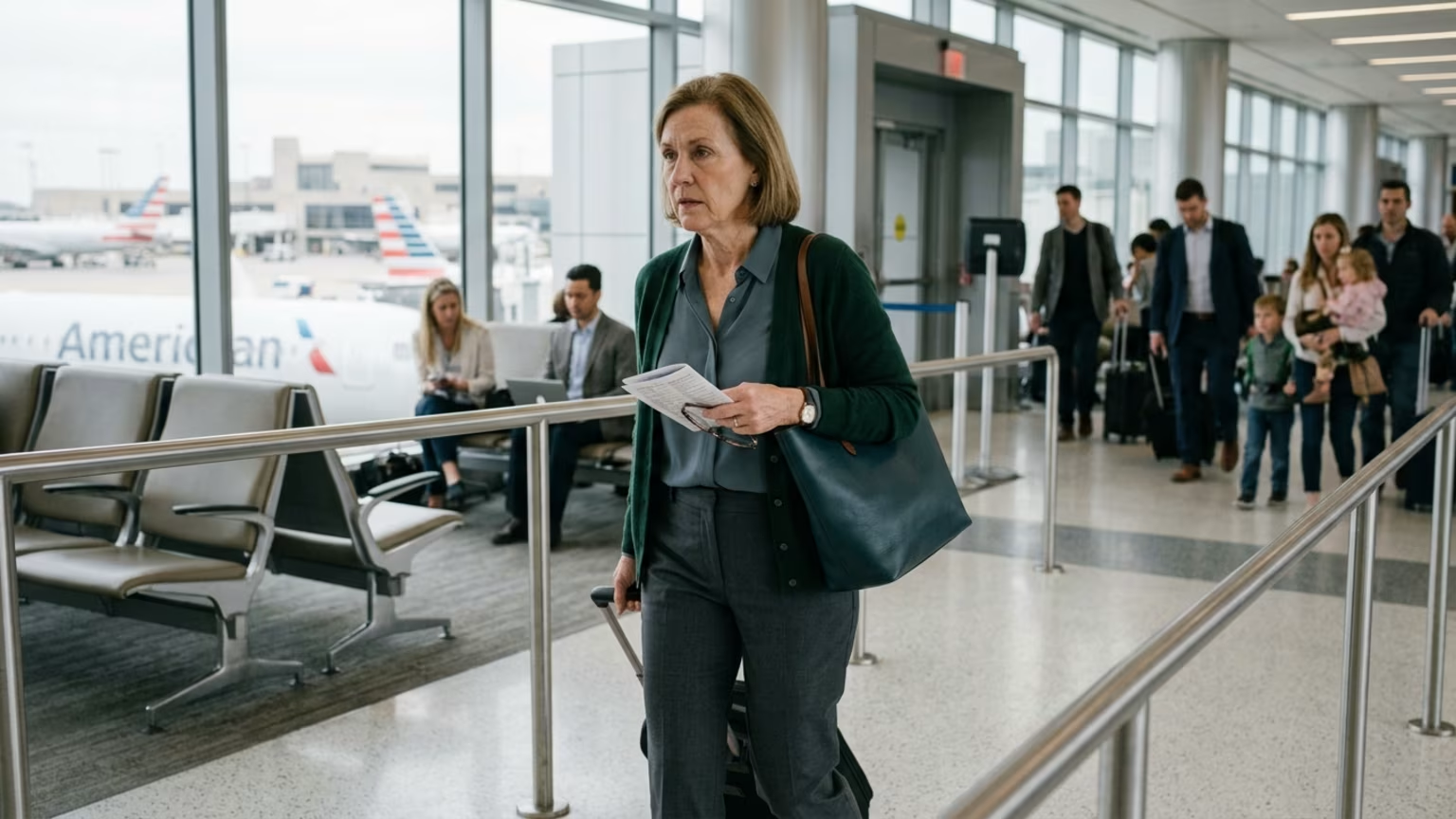

New research links poor sleep to increased conflict with supervisors. ExecuFuel explores how fatigue compromises behavioral control and executive performance.





For executives and team leaders, understanding the root causes of workplace friction is essential for maintaining operational efficiency. On September 24, 2026, a report from Human Resources Director stated that a new study links poor sleep with increased conflict involving supervisors and other higher-ranking colleagues. The findings frame rest not just as a personal health metric but as a critical operational factor in organizational communication. This research highlights how physiological deficits can manifest as interpersonal tension.
According to the report, the research analyzed data from U.S. Army soldiers to examine how fatigue affected interpersonal friction across different levels of hierarchy. The central reported finding was that poorly rested employees were significantly more likely to clash with their supervisors than with peers or subordinates. When participants were adequately rested, conflict reportedly remained low across all relationship types. The article identifies the underlying study as Sleep and Strife: The Effects of Sleep on Conflict within Organisational Hierarchy, noting it was published in August 2026.
These findings reinforce the operational argument for prioritizing sustainable working conditions in demanding professional environments. The data suggests that conflict increases generally when rest deteriorates, but the increase is greatest in interactions with supervisors. Organizations that ignore the role of fatigue in communication may inadvertently create a culture of unnecessary escalation.
The report attributes the research to teams from Johns Hopkins Carey Business School, the University of South Carolina, and the Walter Reed Army Institute of Research. According to the findings, the sharpest increase in conflict occurred specifically when poorly rested employees interacted with higher-ranking colleagues. Peer interactions may involve weaker social expectations, which could explain why the friction was less pronounced among colleagues of equal rank. The proposed mechanism for this upward friction is a measurable reduction in self-control.
Brian Gunia, identified by the report as a professor and area chair for management and organization at Johns Hopkins Carey Business School, explained this dynamic. He noted that managing upward requires people to follow stricter workplace norms and exercise a higher degree of behavioral regulation. Gunia suggested that sleep problems compromise self-control, making it harder for individuals to suppress frustration and choose their words carefully during interactions with senior colleagues.
This interpretation focuses on active behavioral regulation rather than just a generalized sense of irritability. In practical terms, the theory implies that poor sleep depletes the mental resources required to manage status-sensitive conversations. This becomes especially relevant when an employee must disagree, receive criticism, or raise a complex problem with someone holding greater authority. The effort required to maintain professional composure simply becomes harder to sustain when rest is compromised.
In standard peer interactions, social expectations are often more relaxed, allowing employees greater flexibility in how they communicate frustration. When dealing with a supervisor, the margin for error is significantly smaller. Employees must actively select diplomatic phrasing, an executive function that relies heavily on a well-rested brain. If fatigue erodes that regulatory capacity, ordinary disagreements can easily escalate into formal conflict.
For founders and senior operators, these findings support treating sleep and recovery as direct inputs into communication quality. This is especially true before high-stakes conversations involving disagreement, escalation, or negotiation. The report quotes the researchers as saying that organizations should use whatever structural levers they can to support employee rest. This includes reviewing schedules, assessing workloads, and setting clearer norms for after-hours communication to maintain a stable operating environment.
The necessity of a strong physical foundation for managing pressure is something we see consistently. During the toughest quarter of my career, I noticed that my ability to handle stress was directly tied to my cardiovascular fitness, not my mindset. I was trying to meditate my way out of a physiological deficit. Once we started looking at the data connecting aerobic capacity to emotional regulation and executive function, everything clicked. Physical capacity is the absolute foundation of mental resilience.
Sleep operates on this exact same principle, serving as a non-negotiable input for effective leadership. When an executive attempts to navigate complex interpersonal challenges on inadequate rest, they are trying to out-think a biological deficit. The human brain requires sufficient recovery to process nuance, regulate emotion, and manage the delicate power dynamics inherent in any corporate structure. Treating rest as an operational tool is a practical risk management strategy.
Leaders can create a smoother operational tempo by distinguishing genuine urgency from constant availability. A separate 2023 study summarized by HEC Paris offers adjacent evidence on this front. It found that perceived pressure to perform extra-role work increased fatigue among married professionals in India. Interestingly, performing the extra-role behavior itself did not produce the same increase in exhaustion, suggesting that the psychological burden of implied expectations carries its own weight.
That same HEC Paris summary reported that better sleep weakened the relationship between perceived citizenship pressure and fatigue. This highlights the importance of sleep leadership, an approach mentioned in the Human Resources Director report where managers actively encourage healthy rest. Executive teams should be cautious about scheduling consequential conversations immediately after overnight travel or compressed deadlines. A simple organizational safeguard is to delay an emotionally charged message until all parties have had sufficient rest.
The HEC Paris summary also noted that formal working hours can appear reasonable while employees still feel pressure to perform additional work. This dynamic can spill over into personal lives in meaningful ways. The summary reported that higher fatigue was associated with less evening social activity with spouses, while spousal recovery support weakened that relationship. This provides clear evidence that work pressure and recovery affect behavior well beyond the office walls.
While the findings offer practical insights, ExecuFuel prioritizes intellectual honesty regarding the limitations of any new data. The most significant caveat is that the primary study itself was not publicly accessible in the available research materials. The central claims rely on a single trade publication report from Human Resources Director rather than a directly reviewed journal article. Furthermore, the available reporting does not disclose the study’s exact participant count, sleep measurement methods, or statistical effect sizes.
The analyzed population consisted entirely of U.S. Army soldiers, meaning the results should not automatically be generalized to corporate executives or civilian knowledge workers. Military hierarchy and operational stress differ substantially from the communication norms in a startup or professional services firm. Without controls for factors like shift work, deployment conditions, or overall workload, the generalizability of the reported relationship remains difficult to independently verify.
Another critical limitation is the definition and measurement of workplace conflict. The available reporting does not detail how conflict was quantified, whether through self-reported surveys or formal disciplinary records. Without a clear understanding of the conflict measurement method, we cannot determine if the study captured severe insubordination or merely minor verbal disagreements. Executives should therefore view the research as a useful diagnostic framework rather than a definitive predictive model.
Additionally, the available report does not establish that poor sleep alone caused the observed conflict. Reverse causation is a highly plausible alternative, as conflict with a supervisor may increase stress and burnout and subsequently degrade sleep quality. The proposed self-control mechanism remains an expert interpretation of the findings rather than a complete causal demonstration. The evidence supports viewing poor sleep as a potential risk factor for upward friction rather than an absolute determinant of professional behavior.
The conversation around workplace fatigue is shifting from individual habits to structural organizational design. The report places sleep within a broader organizational performance framework, noting that interpersonal friction can undermine collaboration and create downstream effects for productivity. Moving forward, we expect to see more organizations formally incorporate fatigue management into their operational strategies. This is particularly likely in sectors like healthcare, emergency services, and aviation where fatigue-related friction carries heightened operational consequences.
Leaders who recognize fatigue as a systemic issue will be better positioned to maintain high-performing teams over the long term. This means questioning cultures that reward constant responsiveness over deliberate, high-quality work. Organizations that actively review workloads and communication expectations will likely see a measurable reduction in preventable friction. Ultimately, protecting time for recovery is a calculated strategy for sustaining organizational resilience.
As researchers continue to study the intersection of rest and workplace dynamics, future clinical trials will likely seek to quantify these behavioral impacts in civilian corporate environments. Until those specific effect sizes are published, organizations should avoid using sleep monitoring as a covert performance or disciplinary tool. The strongest defensible business message is simply that poor sleep reduces the emotional bandwidth required for status-sensitive interactions, making healthy aging and executive longevity a valid operational priority.
Stay connected for research and practical guidance on executive performance, energy, focus, sleep, recovery and longevity. Ideas built for people who want to stay sharp, capable and effective for the long run.





Build habits and systems that support clear thinking, steady energy and long term capacity throughout a demanding career.
explore the Blog