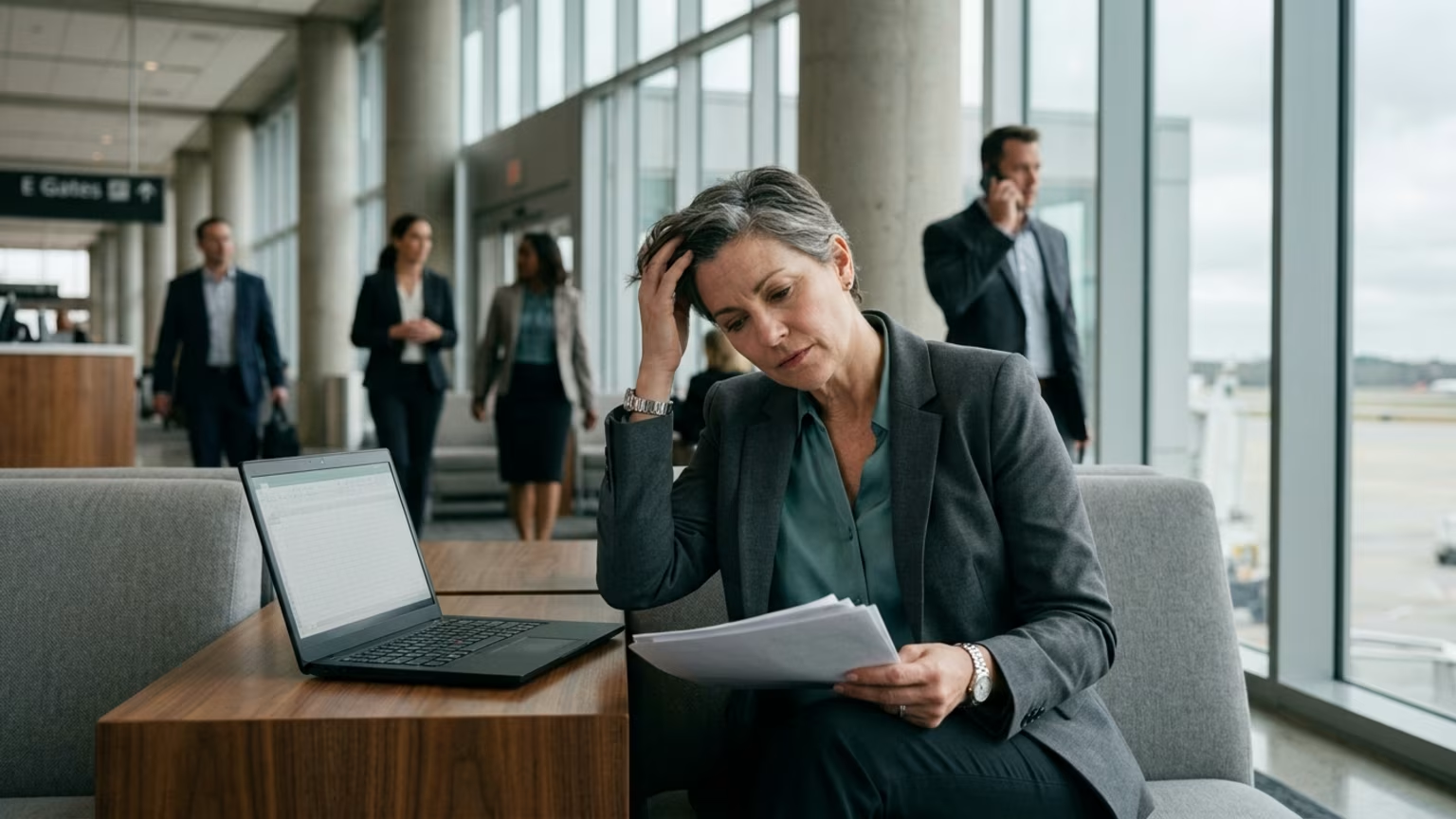

Recent research challenges the effectiveness of weekend catch-up sleep. Learn how consistent schedules and precise protocols protect executive cognitive capacity.





Sleeping for ten hours on a Sunday will not erase the cognitive damage of a demanding workweek. Executives often treat weekend recovery like a bank account, assuming large deposits can directly offset a massive deficit. The data tells a very different story. In a study of severe sleep loss, a 90-minute nap helped preserve episodic memory after 30 hours of wakefulness, resulting in a 22% performance advantage over controls.
This precise intervention preserved function during extreme deprivation, but it highlights a broader truth about recovery. The Washington Post recently synthesized recent sleep research, emphasizing that weekend catch-up sleep does not reliably erase accumulated sleep debt. Adding extra hours of rest on your days off may temporarily improve how you feel. It does not correct the underlying physiological strain caused by chronic sleep restriction.
The evidence suggests that professionals must completely rethink their approach to sustained energy. True operational capacity requires an intentional strategy rather than a sporadic weekend binge.
Sleep research is moving beyond simple duration metrics to examine biological aging and organ-specific health. A 2026 analysis reported the lowest measured biological-aging levels among people who reported sleeping about 6.4 to 7.8 hours per day. This reported association extended across biological measures involving the brain, heart, lungs and immune system. The data presents a U-shaped interpretation where shorter and longer sleep durations were associated with less favorable aging profiles.
Mark Lachs, co-chief of geriatrics at Weill Cornell Medicine, described this relationship as a Goldilocks phenomenon. He noted that both insufficient and excessive sleep may be problematic for human health. The 6.4-to-7.8-hour range is an observed association, not a universal medical prescription. An executive who naturally needs more sleep should not arbitrarily compress their schedule to fit this exact window.
This complicates the simplistic message that more sleep is always the ultimate answer for high-performing professionals. Observational sleep research can also reflect reverse causation, meaning that longer sleep might result from an underlying illness. These findings represent associations rather than a randomized trial proving that changing your sleep directly changes your biological age.
Consistency matters more than forcing a specific duration on any given night. Kimberly Fenn, a Michigan State cognition researcher, told The Washington Post that large shifts in sleep and wake times can increase fatigue. This means that sleeping far later on a Sunday can disrupt your baseline rhythm and leave you feeling worse. A volatile schedule actively undermines the bodily systems responsible for maintaining your daily energy.
The professional cost of carrying unresolved sleep debt is immense and immediate. Sleep loss directly impairs memory formation, future planning and complex decision-making. A significant drop in episodic memory performance changes the outcome of high-stakes negotiations and board meetings. When your brain fails to correctly index recent events, your ability to read a room or adjust strategy vanishes entirely.
Executive work demands constant context switching and intense emotional regulation throughout the day. A fatigued leader often defaults to reactive choices instead of executing a deliberate strategy. This cognitive decline happens slowly, making it difficult for the individual to recognize the deficit in real time. Attempting to fix this operational drag by sleeping until noon on a Saturday creates a dangerous false sense of security.
This biological reality cannot be ignored when the pressure mounts. I remember landing at Heathrow after a brutal overnight flight from New York. I had a board meeting in three hours. The standard advice of getting eight hours of sleep felt like a cruel joke.
That was the exact moment I realized our readers do not need perfect scenarios. They need triage protocols. They need to know what the science says about recovering cognitive function when you only managed three hours of terrible sleep at high altitude. Leaders must learn to preserve cognitive capacity using precise tools rather than relying on false hope.
The impact of fatigue varies widely depending on individual health markers and age. An exploratory analysis of 686 older adults found an association between more napping minutes and slower processing speed. The researchers noted that the relationship between napping and executive function differed in some participants with sleep apnea. This highlights the danger of adopting generalized advice without understanding your specific physiological context.
Instead of obsessing over a single sleep target, leaders should track their daily cognitive function and emotional baseline. Decision quality, reaction speed, and the ability to sustain attention are incredibly useful operating indicators. A leader who naturally sleeps seven hours but struggles with basic concentration may be dealing with poor sleep architecture. These functional metrics provide a much clearer picture of your actual recovery than the raw hours spent in bed.
Leaders who spend enough time in bed but still experience severe daytime fatigue must investigate further. Masking persistent exhaustion with stimulants or afternoon naps ignores the root problem entirely. Conditions like sleep apnea quietly destroy cognitive endurance and require professional medical evaluation. Ignoring these hidden variables makes any recovery strategy fundamentally incomplete and potentially harmful.
Building a robust sleep and recovery routine requires replacing the weekend binge strategy with a stable weekly operating system. The Washington Post recommends maintaining a consistent sleep schedule and using only limited recovery measures. If you suffer a short night, try waking approximately one hour later instead of sleeping until noon. You might also take a 20-minute afternoon power nap to clear temporary fatigue without ruining your nightly rhythm.
The 90-minute nap study demonstrates the value of precise recovery tools during extreme situations. The intervention groups managed a 22% higher memory performance than controls after 30 hours of uninterrupted wakefulness. However, this was an acute intervention designed to test episodic memory under severe stress. This specialized protocol should not be used to justify long daytime naps as a cure for chronic sleep restriction.
Strategic naps are useful, but they carry specific operational risks for busy professionals. A mid-day nap can produce sleep inertia, which is temporary grogginess or disorientation upon waking. This physiological reality means you must allow time to clear your head before making critical decisions. You should never schedule a major presentation or a financial review immediately following a recovery nap.
The supplement market is another area requiring extreme caution and clinical oversight. The Washington Post reports that sleep experts view melatonin as potentially useful for jet lag or shifted sleep timing. Magnesium has a much thinner evidence base for treating insomnia. According to a review of American Academy of Sleep Medicine guidance, melatonin provides limited benefits for chronic insomnia.
The meta-analysis cited in that review found only about an eight-minute reduction in sleep-onset latency. Routine over-the-counter use of these compounds is not supported for chronic sleep issues. A 2026 Australian joint position statement reported that melatonin may be considered for up to 13 weeks in specific circumstances. The same statement noted that sedative-hypnotic drugs may be limited to two to four weeks.
Executives must treat supplement use as a serious clinical decision rather than a casual habit. Before taking melatonin or magnesium regularly, leaders should review the dosage and interactions with a qualified doctor. Self-prescribing these compounds for chronic insomnia contradicts the cautious position taken by major sleep medicine organizations. Medical supervision ensures that underlying problems are treated correctly rather than temporarily suppressed.
Maintaining sustainable executive performance requires treating sleep regularity as a non-negotiable operational variable. Relying on erratic weekend sleep marathons or unregulated supplement use creates a cycle of constant fatigue. Small adjustments to your daily routine compound significantly over the course of a demanding career. A stable schedule builds the necessary foundation for clear thinking and resilient leadership.
True operational endurance is not found in a single massive catch-up session. It emerges from the quiet discipline of honoring your daily physiological limits. As the data clearly shows, the body keeps an accurate ledger of your stress and recovery. Respecting that ledger remains the only proven path to lasting professional capacity.
Stay connected for research and practical guidance on executive performance, energy, focus, sleep, recovery and longevity. Ideas built for people who want to stay sharp, capable and effective for the long run.





Build habits and systems that support clear thinking, steady energy and long term capacity throughout a demanding career.
explore the Blog