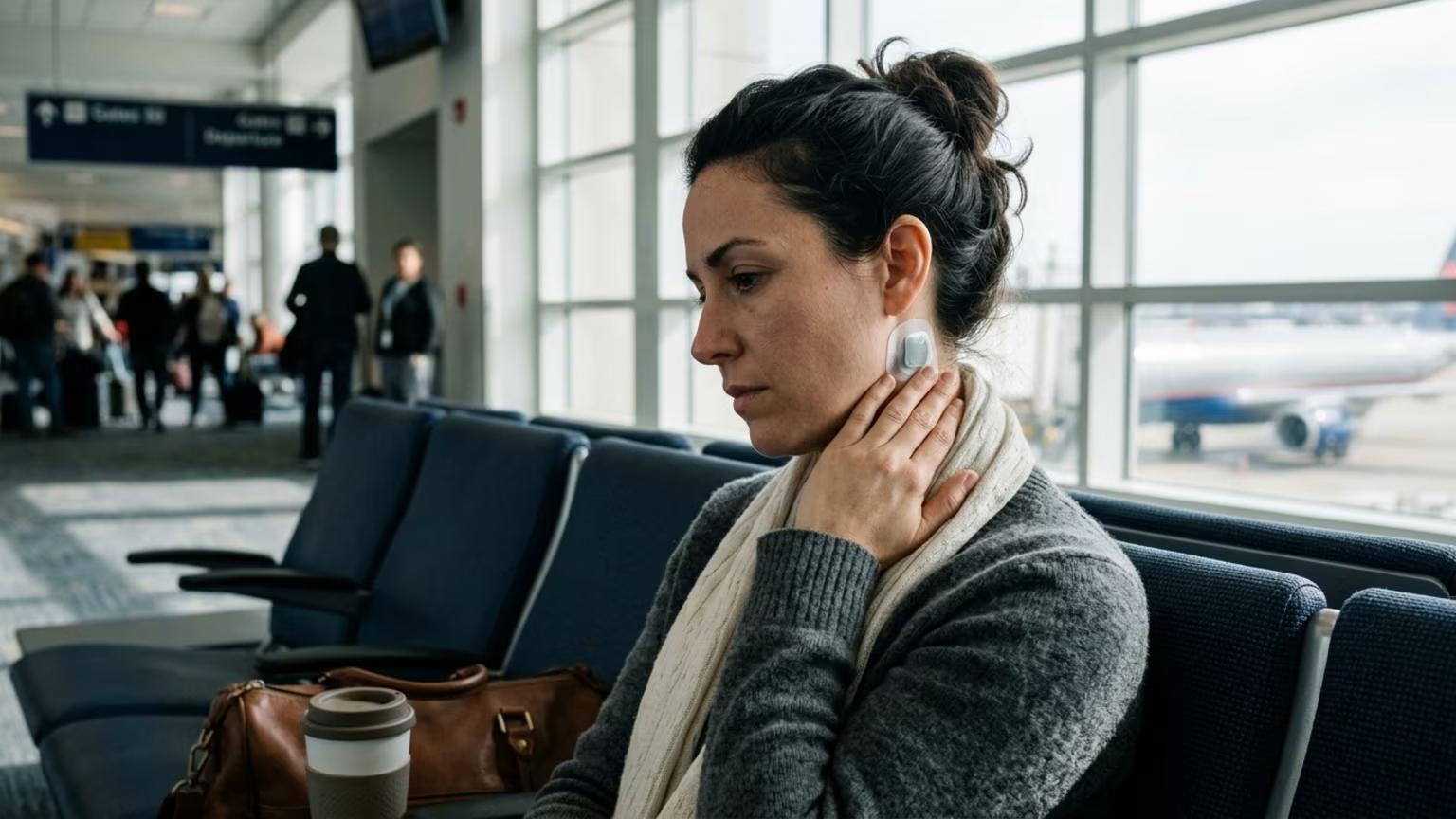

A new pilot study shows the NEUSLeeP wearable ultrasound patch increased REM sleep by 16 minutes per night. Discover the data behind active sleep modulation.





I remember landing at Heathrow after a brutal overnight flight from New York. I had a board meeting in three hours. The standard advice of getting eight hours of sleep felt like a cruel joke. That was the exact moment I realized our readers do not need perfect scenarios.
They need triage protocols. They need to know what the science says about recovering cognitive function when you only managed three hours of terrible sleep at high altitude. This is why the development of the NEUSLeeP wearable ultrasound patch is so compelling. The prototype device recently increased REM sleep from 16.3% to 20.9% in an overnight study.
Researchers at the University of Texas at Austin developed the NEUSLeeP prototype. The flexible patch combines electrophysiological sensors with transcranial ultrasound. It is designed to monitor sleep while actively stimulating deep brain structures. This dual approach moves the sleep technology industry far beyond basic movement tracking.
The research team tested the system in an overnight study involving 28 adults. They successfully gathered usable sleep recordings from 26 participants. The full results were published in Nature Communications on June 4, 2026. The findings reveal significant changes in how the brain cycles through its recovery phases.
Under sham stimulation conditions, participants spent 16.3% of their night in REM sleep. With active ultrasound stimulation applied, that share rose to 20.9%. This 4.6 percentage point shift translated to approximately 16 additional minutes of REM sleep per night. For an executive facing chronic sleep compression, this represents a meaningful biological gain.
The timing of the sleep stages shifted significantly during the experiment. Participants reached their first REM episode approximately 43 minutes earlier with active stimulation. The average REM latency fell from about 177 minutes to roughly 135 minutes. This faster onset could prove highly beneficial during restricted sleep windows.
The technology specifically targets the left subthalamic nucleus. This deep brain structure plays a key role in motor and sleep-related circuits. Focused ultrasound is delivered safely through the skull while the system records electrophysiological signals. This allows researchers to monitor sleep-stage changes in real time.
The dual function of the NEUSLeeP system makes the pilot study particularly notable. The technology does not merely pulse acoustic energy blindly into the brain tissue. It continuously records physiological signals during sleep to observe the immediate bodily response. This creates a foundation for closed-loop systems capable of adapting to the user.
Future technologies designed to influence sleep architecture will likely require this exact bidirectional capability. Active interventions must be precise to avoid disrupting the delicate balance of sleep stages. The researchers reported that the intervention increased REM sleep without materially changing other reported sleep stages. It also maintained overall sleep efficiency and did not cause disruptive nighttime awakenings.
The ability to actively manipulate REM sleep carries immense implications for high-performing professionals. Gregory Fonzo served as a co-principal investigator on the project. Fonzo described REM sleep as being highly relevant to emotional reset and stress adaptation. These specific physiological functions are critical for maintaining sharp cognitive endurance during high-stakes work.
A deficit in emotional regulation creates immediate and expensive boardroom liabilities. When leaders fail to secure adequate REM sleep, they routinely experience compromised emotional control. This deficit translates directly to poorer reactions during complex negotiations or marathon work sessions. A small loss of emotional resilience can easily compromise critical corporate decisions.
Most executives currently rely entirely on passive tracking to understand their sleep debt. They use consumer wearables to observe their sleep stages without any mechanism to change them. A shift from passive observation to active intervention would fundamentally alter executive performance strategies. It would turn recovery from a historical record into a controllable biological lever.
The traditional approach to corporate wellness heavily emphasizes total time spent in bed. Leaders are constantly told to aim for eight hours of uninterrupted rest. However, total duration matters little if the brain fails to cycle through deep recovery phases. The quality of sleep architecture determines whether a leader wakes up prepared for high-level problem solving.
Active neuromodulation devices could eventually offer a targeted solution for short sleep windows. Travel schedules and urgent deadlines frequently limit total time in bed for busy founders. If a wearable could accelerate the onset of REM sleep, it might help offset some acute sleep loss. This potential efficiency gain is precisely what attracts ambitious operators to emerging sleep science.
The institutional backing for this technology highlights a serious interest in human performance enhancement. The research was associated with support from the DARPA REM-REST program. It also received backing from the National Institutes of Health and the National Science Foundation. The prototype is currently advancing through the university commercialization unit under a patent application.
The University of Texas team sees profound potential beyond daily corporate recovery. They plan larger studies to evaluate possible applications in PTSD, depression, and chronic insomnia. These remain future research directions rather than established medical treatments. However, they highlight the serious clinical potential of non-invasive brain stimulation.
The pilot study revealed important details about who actually benefits from the stimulation. The participant group included both healthy adults and people with mild insomnia symptoms. The reported ages ranged narrowly from 19 to 38 years. This relatively young sample limits immediate generalizability to older executives or broader clinical populations.
Baseline health status appeared to strongly influence the physiological response. The healthy participants demonstrated a clear increase in overnight heart-rate variability during active stimulation. The mild-insomnia group did not show the same robust autonomic response. Their changes in REM latency were also much less pronounced than those seen in healthy sleepers.
The study design introduced several variables that require careful and critical interpretation. The research protocol used a fixed testing sequence rather than randomizing the experimental conditions. Participants always underwent a sham night followed by an active-stimulation night. This single-blind approach means order effects or standard night-to-night variation could have influenced the outcomes.
Furthermore, the intervention was evaluated over just two consecutive nights. This extremely short duration leaves several critical long-term performance questions entirely unanswered. It remains unclear if the REM increase is durable over months of continuous use. It is also unknown if repeated stimulation produces a tolerance effect that diminishes the benefits.
Crucially, a larger REM share is not automatically equivalent to better daily performance. The researchers successfully measured sleep architecture and related physiological signals. However, the study did not demonstrate improved executive function, memory, or daytime productivity. Professionals must separate measured biological changes from proven workplace advantages.
The NEUSLeeP device remains an early-stage research prototype today. It is definitively not a commercially available consumer product. Therefore, professionals must build a reliable recovery structure using proven behavioral strategies. You cannot buy a clinical patch to fix your sleep architecture right now.
Operators should focus on tracking their personal recovery metrics to guide intentional behavioral changes. Use passive wearables to monitor your baseline REM duration and latency trends. Pay close attention to how late meals or evening alcohol consumption affect these metrics. Small behavioral adjustments often yield measurable and lasting improvements in your nightly data.
Readers looking for proven executive performance frameworks know that consistency remains the most powerful tool. Going to bed at the exact same time anchors your natural circadian rhythm. This regularity helps your brain transition into REM sleep far more efficiently. It reduces the latency period naturally without the need for transcranial ultrasound.
Light management serves as another highly effective and immediate intervention. Blocking blue light in the evening directly supports your natural melatonin production. Morning sunlight exposure firmly sets your biological clock for the entire day. These basic biological inputs provide a dependable foundation for sustained mental energy and focus.
Stress modulation before bed is equally critical for achieving healthy REM sleep. High evening cortisol levels significantly delay the onset of restorative sleep stages. Implementing a dedicated evening wind-down routine signals to your brain that work is officially over. Reading a book or practicing deep breathing lowers your heart rate before sleep.
Temperature control also plays a vital role in determining your nightly sleep architecture. The human body needs to drop its core temperature to initiate deep rest. Sleeping in a cool room facilitates this necessary biological transition with remarkable consistency. A room temperature around 65 degrees Fahrenheit generally supports faster sleep onset and better stage cycling.
Strategic caffeine consumption is another critical variable within your daily control. Adenosine accumulation throughout the day creates the natural sleep pressure required for healthy rest. Consuming caffeine late in the afternoon forcefully blocks these adenosine receptors and disrupts evening sleep architecture. Implementing a strict midday cutoff preserves your ability to achieve adequate REM sleep naturally.
The transition from passive tracking to active sleep neuromodulation represents an exciting frontier. The University of Texas study provides a compelling proof of concept for the future. Adding 16 minutes of REM sleep could meaningfully impact your long-term stress adaptation. Over an entire career, these small daily advantages accumulate into massive physiological disparities.
However, new technology will never fully replace the absolute fundamentals of human biology. Future wearables might eventually assist in shortening REM latency or enhancing specific brain waves. They will still strictly require the user to allocate sufficient time in bed. You cannot artificially stimulate your way out of a severe chronic sleep deficit.
The corporate leaders who perform best over decades focus on reliable daily routines. They understand that physical recovery is a continuous and compounding biological process. A measured approach to sustaining mental clarity requires immense patience and discipline. It demands that we treat our baseline physiological health as our most valuable asset.
Review your current sleep environment tonight and eliminate one source of ambient light.
Stay connected for research and practical guidance on executive performance, energy, focus, sleep, recovery and longevity. Ideas built for people who want to stay sharp, capable and effective for the long run.





Build habits and systems that support clear thinking, steady energy and long term capacity throughout a demanding career.
explore the Blog