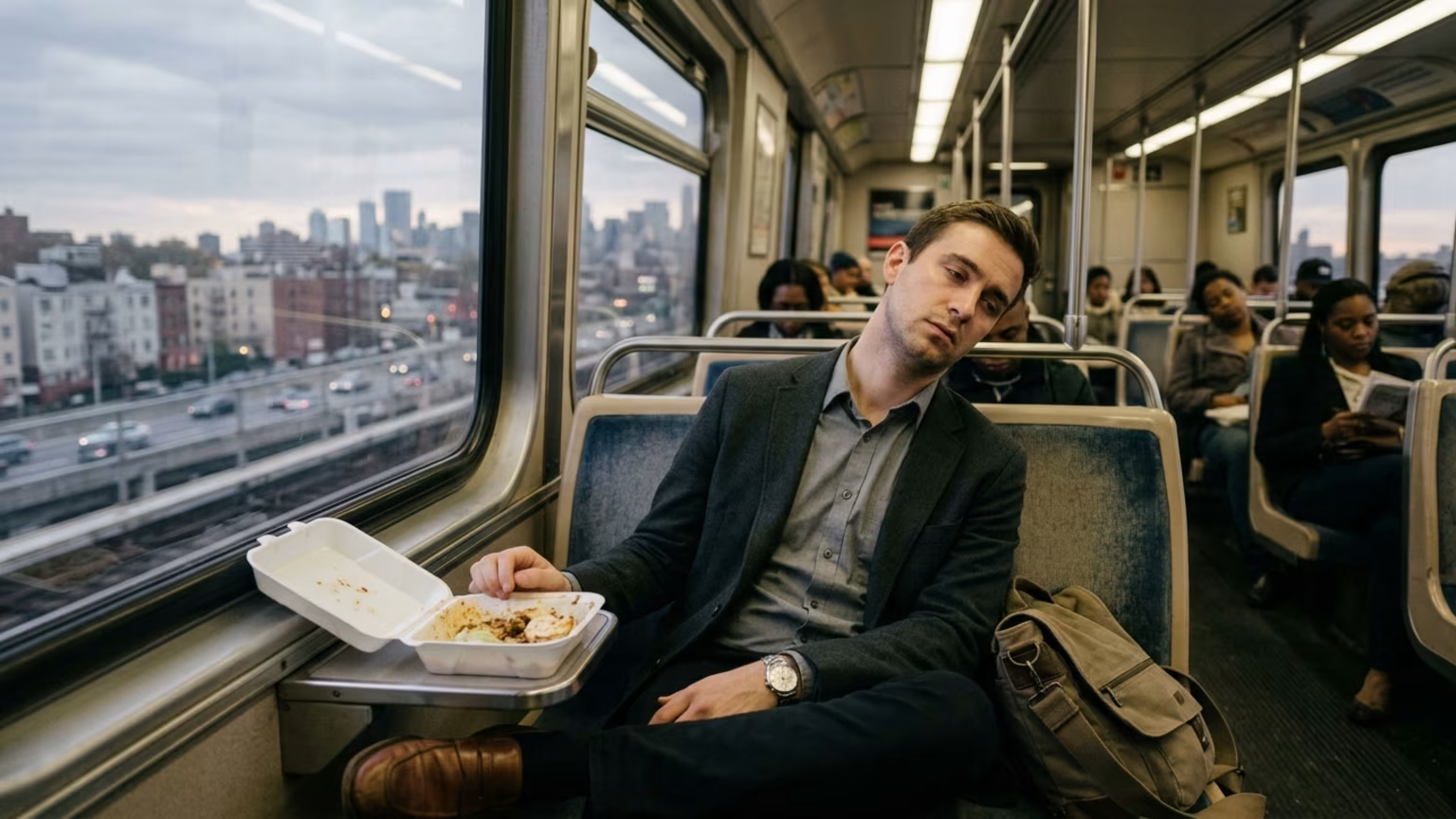

The EYVA India Wellness Index 2026 reveals how late dinners, long commutes, and late caffeine lower sleep quality and morning readiness for urban professionals.





On September 21, 2026, Mid-day published findings from the India Wellness Index 2026 by EYVA. The report examined how schedule-driven behaviors affect executive recovery. The data shows that late heavy dinners, long sedentary commutes, and late caffeine consumption are measurably lowering sleep quality. These patterns are also associated with less stable next-morning glucose trends for urban professionals.
The findings offer concrete data on how daily scheduling directly influences sustained professional performance. The way we structure our late afternoons and evenings fundamentally dictates our capacity to perform the next morning. Professionals often view poor sleep as an isolated failure of discipline. However, this data suggests that structural workday elements share a significant portion of the blame.
Demanding routines frequently force essential recovery behaviors later into the night. Busy operators cannot simply force better sleep without addressing the behaviors leading up to bedtime. Commutes, late meetings, and delayed dinners create a cascade effect. This chain of events reliably disrupts the body's natural recovery processes before sleep even begins.
The India Wellness Index 2026 analyzed more than 3.5 million de-identified readings from over 30,000 users. These users were located primarily in urban areas across India. The data comes from EYVA, which produces a touch-based device that generates a snapshot of six wellness indicators in about 60 seconds. This report sought to map how modern work schedules overlap with metabolic, cardiovascular, and respiratory health markers.
The sheer volume of data collected provides a robust look at modern behavioral trends. By analyzing millions of readings, the researchers could identify consistent patterns across a large urban demographic. This scale helps separate isolated incidents from systemic lifestyle habits that define the modern work environment. The core findings highlight the frequency of delayed evening routines among working professionals.
The report found that approximately 54 percent of users consumed their last large meal after 9 p.m. City-specific data showed even later eating patterns in certain regions. Roughly 64 percent of working professionals in Hyderabad ate their final meal after 10 p.m. These delayed schedules carry measurable physiological consequences that carry over into the next day.
Late-dinner nights were consistently associated with lower sleep scores and higher next-morning glucose trends against users' individual baselines. EYVA founder and CEO Sunil Maddikatla noted that late-night dinners have become increasingly common nationwide. He linked the pattern directly to long commutes and necessary adjustments within family routines. The data indicates that professional demands are severely compressing the time needed for physiological reset.
For founders and operators with demanding schedules, the report coverage introduces the concept of a "metabolic hangover." This term describes the combined effect of late meals, stress, and caffeine on next-morning wellness indicators. When a workday extends into the late evening, professionals often compensate by eating heavy meals late. They also frequently consume caffeine to stay alert during the prolonged commute home.
This routine actively degrades the body's ability to clear metabolic fatigue overnight. I spent a week at a popular health conference and left completely exhausted by the complexity. Everyone was pushing a new supplement protocol, a complicated gadget, or a rigid daily routine. It struck me that true high performers do not have time to make health a full time job.
They need maximum return on minimum viable effort. That observation became the filter for every piece of research we publish. This is exactly why these new findings are so practical for demanding professional lives. The report highlights schedule-based behaviors that professionals can actually control with minimal friction.
Moving a large meal earlier, or choosing a lighter option when dining late, can protect overnight recovery. These practical adjustments are critical for maintaining baseline energy over long periods of intense work. Leaders who prioritize energy and physical performance understand that perfect conditions are rare. The goal is to establish low-cost interventions that blunt the impact of a chaotic schedule.
Executives often feel trapped by their schedules, assuming that long hours automatically require health sacrifices. However, building a reliable evening structure is entirely possible even with a late commute. Simple structural changes require much less mental bandwidth than attempting complex lifestyle overhauls. Modifying the timing of existing habits is the most efficient path to better morning readiness.
The India Wellness Index 2026 provided concrete figures on how these habits stack up across different regions. Other city-level figures reported by Deccan Chronicle included 64 percent of Mumbai users recording final meals after 9:30 p.m. Meanwhile, 44 percent of Bengaluru users reported long sedentary commutes that reduced their daily movement. These localized statistics reveal a broader trend of compressed evening schedules across major professional hubs.
Caffeine consumption also played a significant role in the recorded physiological patterns. Deccan Chronicle reported that about 40 percent of users consumed caffeine within six hours of bedtime. This late consumption directly competes with the body's ability to initiate deep, restorative sleep phases. Implementing a strict caffeine cutoff time based on a realistic bedtime is a highly effective starting point.
The report also noted that heavy, salty, and fried late meals were associated with elevated vascular-pressure trends in roughly one in three users. This specific vascular-pressure pattern was reportedly strongest in Delhi. However, the data also highlighted actionable pathways for mitigating these physiological effects. Approximately 37 percent of users who logged activity after meals showed 12 to 16 percent flatter glucose trends and improved sleep.
This simple post-meal movement acts as a direct countermeasure to sedentary workday habits. A short post-meal walk allows leaders to actively support cognitive performance and mental clarity the following day. Moving for just a few minutes helps the body process the evening meal before sleep. This approach is highly efficient for individuals managing dense professional calendars.
While the findings are compelling, intellectual honesty requires clearly defining the limitations of the data. The EYVA findings are reported as associations, not randomized evidence that late dinners or caffeine independently caused poorer sleep. The reported 12 to 16 percent glucose improvement among users who logged post-meal activity is purely observational. This may simply reflect self-selection, as people who walk after meals might also maintain healthier diets.
Furthermore, the user base consisted primarily of urban professionals using EYVA technology. These results may not generalize to rural populations or individuals without access to wellness trackers. The reported percentages also use different definitions of a late dinner, ranging from after 9 p.m. to after 10 p.m. These figures measure slightly different thresholds and should not be treated as a single unified standard.
It is also crucial to remember that observational data cannot prove causation. A late meal may be less consequential than its composition, portion size, or an individual's unique metabolic context. The findings provide a helpful framework for experimentation rather than an absolute rulebook. True performance management requires testing these associations against your own personal baseline.
Finally, the tracking technology itself has defined technical boundaries. EYVA's product materials describe the device as a lifestyle-wellness product, not a diagnostic or treatment tool. The readings provide supplemental information for monitoring general trends over time. Any professional managing diagnosed metabolic conditions should consult a qualified clinician rather than relying solely on consumer hardware for healthy aging and executive longevity decisions.
The data from the India Wellness Index 2026 points toward a shift in how we measure professional readiness. We are moving away from isolated metrics like step counts and toward integrated tracking of overlapping behaviors. The relationships between commute times, meal windows, and subsequent sleep quality offer a more realistic picture of human performance. Corporate leaders should view these insights as essential operational data.
Companies are also beginning to recognize that employee commutes are a structural recovery issue. Expect to see forward-thinking organizations adjusting meeting schedules and travel expectations to protect evening recovery windows. Recognizing the physiological toll of long commutes and late meals is the first step toward better corporate policy. As this science matures, we anticipate a stronger focus on designing workdays that actively support sustainable human output.
Future developments will likely focus on providing contextual insights rather than simple numerical scores. As devices become faster and more integrated, professionals will gain clearer visibility into how their specific work schedules impact their physiological capacity. This evolution will help ambitious operators build sustainable routines that respect both their professional ambitions and their physical limits. The future of performance tracking lies in adapting to reality, not ignoring it.
Stay connected for research and practical guidance on executive performance, energy, focus, sleep, recovery and longevity. Ideas built for people who want to stay sharp, capable and effective for the long run.





Build habits and systems that support clear thinking, steady energy and long term capacity throughout a demanding career.
explore the Blog