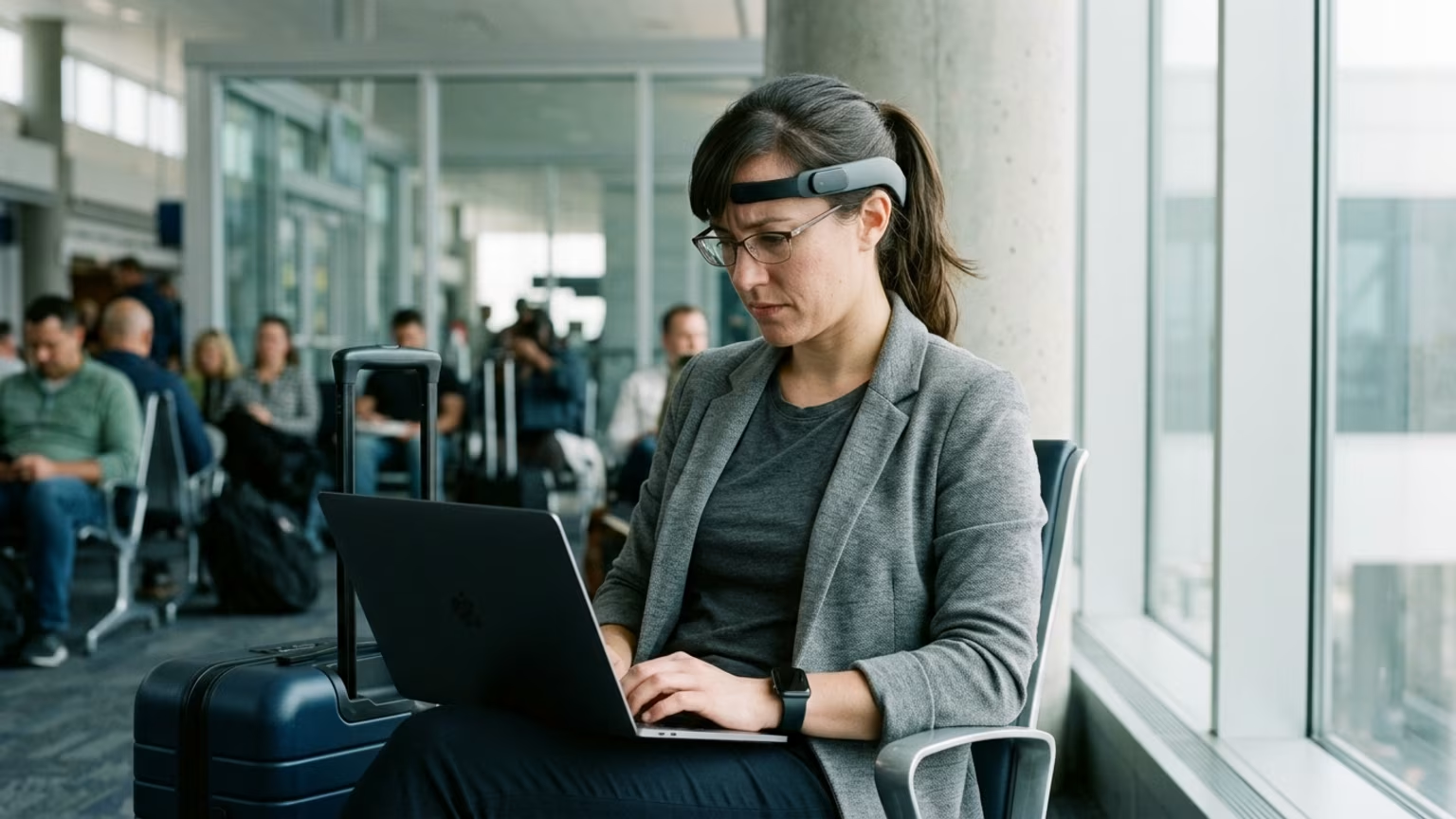

Neurostellar tested its Orbit headband to track cognitive endurance during a chess tournament. We examine what this means for executive performance monitoring.





On September 24, 2026, news outlets reported that Neurostellar tested a new forehead-worn device during a live chess tournament. The Chennai-based deep-tech startup, described as an IIT-Madras startup, used its Orbit headband to track participants during active competition. The event was organised alongside CircleChess under the Battle of Brains format. This specific tournament structure focuses on monitoring cognitive speed, agility and endurance in real time.
The device is designed to track these exact metrics during periods of sustained concentration. Neurostellar CEO Karthik Raghavendran stated that the system outputs are intended to quantify how long a player can sustain focus. The recent test represents an early monitoring application rather than validated evidence that the hardware improves executive capabilities.
The third edition of this hybrid tournament took place at the Velammal campus in Chennai. Twenty-four players wore the Orbit device while competing in the event. Participants competed online through the Caissa platform while physically gathered together. CircleChess says the format aims to capture calculation, decision-making and performance under pressure alongside traditional chess moves.
Orbit combines electroencephalography (EEG) sensors with photoplethysmography (PPG) sensors to capture activity. EEG technology is intended to monitor brain activity directly. Meanwhile, PPG sensors capture physiological signals associated with cardiac function. Neurostellar says these combined data streams are processed to estimate a user's overall cognitive endurance.
During the event, spectators viewed a live dashboard ranking players by cognitive endurance rather than their standard game scores. Participants received detailed reports after the event intended to help them identify periods of lost focus or errors. The company states its proprietary algorithms were developed in collaboration with scientists at the National Institute of Mental Health and Neurosciences (NIMHANS). The system reportedly produces an endurance score within seconds.
Raghavendran explicitly contrasted the Orbit system with conventional smartwatches. He noted that while traditional wearables focus on physical fitness, this device attempts to measure mental performance during peak cognitive activity. The company has conducted two earlier editions of its hybrid chess tournament at IIT-Madras. The recent Chennai event included tournament rewards specifically tied to cognitive endurance.
The corporate environment requires long stretches of high-stakes concentration. Founders and operators often work through prolonged periods of pressure and complex decision-making. Tools that attempt to quantify mental stamina appeal directly to data-driven professionals. The promise of identifying exact moments of cognitive fatigue is a highly compelling proposition for demanding work environments.
I recently spent a week at a popular health conference and left completely exhausted by the complexity. Everyone was pushing a new supplement protocol, a complicated gadget or a rigid daily routine. It struck me that true high performers do not have time to make health a full-time job. They need maximum return on minimum viable effort.
That core observation filters how our team views new performance technology. A device like Orbit offers an intriguing premise for professionals managing their workload. Instead of guessing when mental fatigue sets in, operators could theoretically identify precise periods of lost focus. However, buyers should treat early consumer neurotechnology as a feedback tool rather than a final judgment of capability.
Corporate environments increasingly demand data to validate operational choices. While physical health tracking is now common among leadership teams, cognitive tracking represents a new frontier. Leaders must carefully weigh the administrative burden of introducing another daily metric against the potential benefits of improved mental stamina. For many operators, simple lifestyle adjustments still provide a stronger foundation for sustained performance than raw data collection.
Tracking a mental metric is only useful if it directly supports sustainable cognitive performance and mental clarity. A useful internal experiment would compare device trends with sleep duration, meeting errors and the user's own fatigue ratings. Furthermore, corporate leaders must carefully consider data privacy when evaluating these tools. Brain-related and physiological data can reveal sensitive information about stress and work capacity. Before deploying such tools across a team, organisations must clarify consent and data access controls.
The tournament testing provides several concrete details about the startup's current market progress. Neurostellar reported that more than 50% of participants from the second edition returned for this third event. The company also confirmed that FIDE-rated players participated in the latest competition. The partnership with CircleChess can reportedly produce cognitive reports from sessions lasting approximately 10 to 15 minutes.
The hardware itself is advancing toward broader commercial availability. Neurostellar was taking pre-orders for Orbit at a reported price of $250. The company stated that initial shipments are being made batch by batch. While the current test focused heavily on chess, the company intends to expand its use cases to athletes, golfers and competitive shooters.
The project is led by co-founders Karthik Raghavendran and Dhanushya Sree. Both founders are 2019 biotechnology graduates of SASTRA University. The company is reportedly backed by Ather co-founders Tarun Mehta and Swapnil Jain. This foundational support highlights growing investor interest in specialised performance wearables within the Indian technology sector.
High-profile figures in the chess community have also engaged with the hardware. World Chess Champion Gukesh Dommaraju reportedly used the Orbit device. Additionally, Grandmaster Vishnu Prasanna serves as an adviser to the company and has used the device in his chess-coaching process. These endorsements provide early visibility within the competitive chess ecosystem.
ExecuFuel values intellectual honesty over exaggerated technology claims. The public reports about this device outline an early monitoring application, not validated evidence of performance enhancement. The Chennai test shows that Orbit can collect data during a live event, but it does not prove that wearing the device improves focus or decision-making. The tournament was a demonstration setting rather than a controlled efficacy trial.
Furthermore, a proprietary score is not automatically a validated clinical construct. The available reporting does not disclose the specific algorithm, validation dataset, error rate or test-retest reliability. Chess performance is highly structured and does not perfectly mirror unpredictable executive performance tasks. The sources do not establish that a cognitive endurance score from chess transfers seamlessly to board meetings, investing or engineering.
Physiological signals also have multiple possible explanations in real-world settings. Changes in EEG readings, heart rate or breathing may reflect stress, arousal, physical movement or simply poor sensor fit. The available reporting does not establish that any single physiological change uniquely represents lost focus. BusinessLine specifically noted that Orbit does not make a medical diagnosis.
We must also distinguish between general feasibility and specific device accuracy. A separate systematic review of non-invasive cognitive-load measurement noted that multimodal approaches achieved accuracy as high as 95.4% in examined studies. However, the review also identified gaps in reliability and the transfer of results across contexts. A separate smart-headband study showed that portable EEG devices can capture detectable neural responses, but this does not validate Orbit's exact proprietary score. Commercial availability and pre-orders are indicators of a product offering rather than independent proof of efficacy.
The Orbit test sits within a broader industry shift toward specialised performance devices. BusinessLine identifies Ultrahuman, Temple and NeoSapien as other companies pursuing advanced health-tracking wearables in India. We expect future iterations of these tools to focus heavily on individual calibration. A recent neuroergonomics study involving 40 pilots found that low-cost physiological signals show promise for monitoring stress. However, that study concluded that broader prediction requires individual calibration, stronger reference measures and larger samples.
As the hardware evolves, buyers should closely evaluate the software ecosystems accompanying these devices. Neurostellar's broader offering reportedly includes an app with guided meditation, problem-solving and deep-work sections. It also features a coaching programme intended to help users improve their cognitive scores. We advise professionals to separate the measurement capabilities from these additional coaching features until independent studies verify their long-term impact.
The next critical step for this industry is demonstrating reliable data collection across diverse professional environments. Wearable neurotechnology is clearly capable of producing interesting physiological signals. The challenge lies in translating those raw signals into actionable metrics that respect the realities of demanding professional lives. Until robust independent trials arrive, executives should view cognitive trackers as experimental additions to a stress and burnout management strategy.
Stay connected for research and practical guidance on executive performance, energy, focus, sleep, recovery and longevity. Ideas built for people who want to stay sharp, capable and effective for the long run.




Build habits and systems that support clear thinking, steady energy and long term capacity throughout a demanding career.
explore the Blog