

Discover how slow-wave sleep mediates memory after short nights, and learn actionable protocols to protect executive function under intense schedule pressure.





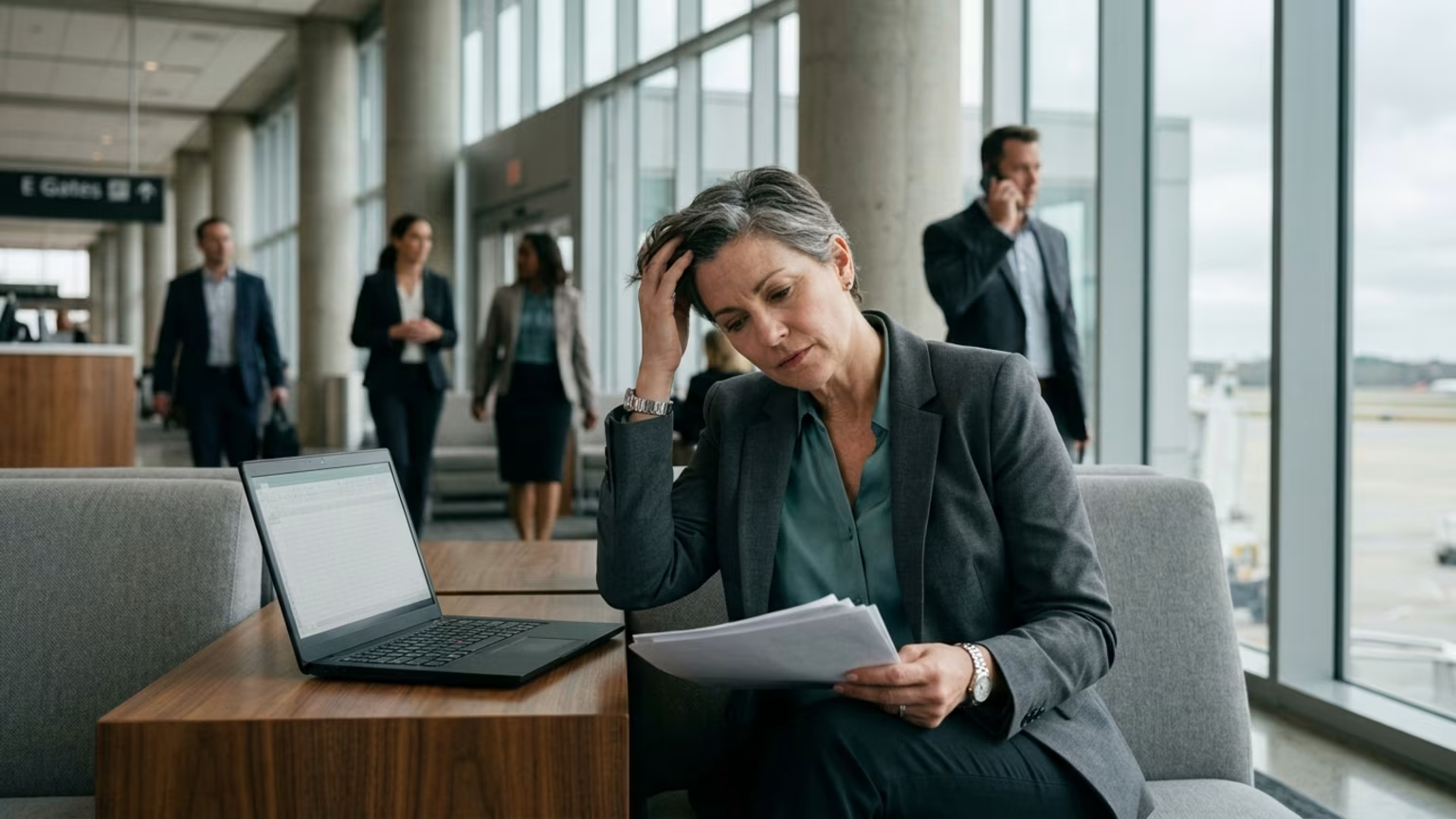
You land at midnight, and your first partner meeting starts at eight in the morning. Your schedule is completely uncompromising. Situations like this force a direct trade between total sleep opportunity and professional preparation. The biological cost of that trade is steep. Leaders often wonder if there is a reliable way to buffer the cognitive deficits that follow a short night.
We need to understand how the brain attempts to compensate for restricted rest. A chief executive recently told me she was drinking six espressos a day just to get through her afternoon strategy sessions. When we looked at the half life of caffeine and her sleep data, the problem was glaringly obvious. Her solution for energy was destroying her deep sleep, which in turn destroyed her energy the next day. We focus on these vicious cycles because breaking them is the fastest way to restore baseline performance.
Recent laboratory research provides a clearer view of how slow-wave sleep functions under stress. A controlled laboratory study published in Sleep examined 88 healthy young adults. The participants had a mean age of 24.0 ± 3.8 years, and 52 percent of them were female. The researchers wanted to see if moderate evening exercise could reduce memory deficits following restricted sleep. They randomly allocated participants to four combinations of exercise and sleep opportunity.
The average sleep condition provided 8.5 hours of sleep opportunity. The restricted condition allowed only 4.5 hours per night. The intervention group completed 30 minutes of moderate-intensity cycling at 55 to 60 percent of VO₂max. This exercise was performed at 7:00 p.m. After the exercise or rest period, participants learned 80 face-name pairs at 10:00 p.m. They then completed immediate and delayed recall testing after polysomnography-recorded sleep.
The results highlighted a specific mechanism of cognitive defense. The study found a statistically significant interaction between exercise and sleep condition for delayed recall. The effect size showed a partial η² of 0.056. Participants who exercised before the restricted night performed significantly better on delayed recall than participants who experienced sleep restriction without exercise. Importantly, the proportion of slow-wave sleep statistically mediated this association.
This mediation finding is critical for understanding memory preservation. It suggests that deep sleep is a primary pathway through which exercise helps protect declarative memory after a short night. However, this physiological mechanism does not mean a single workout replaces adequate rest entirely. The American Academy of Sleep Medicine recommends that adults sleep seven or more hours per night on a regular basis. The restricted protocol of 4.5 hours was substantially below that standard.
Leaders must distinguish between different types of cognitive tasks when evaluating performance. The tested memory task involved learning and recalling face-name pairs. This task assesses declarative memory, which is the ability to recall specific facts or events after a delay. This function is highly relevant when meeting new stakeholders or memorizing briefing documents.
However, declarative memory is not the same as broad executive function. Executive function includes strategic judgment, complex planning, risk assessment, and sustained decision-making. The Sleep paper focused strictly on long-term declarative memory deficits. It did not test broader leadership capabilities or high-consequence negotiation skills. Therefore, no leader should assume a workout will fully erase all cognitive impairments of sleep loss. The findings show a precise benefit for memory consolidation.
Translating clinical findings into a reliable executive performance structure requires discipline. The data supports protecting slow-wave sleep to maintain cognitive output. Here is how to apply these insights to a demanding schedule.
The foundational step is prioritizing total sleep opportunity. The American Academy of Sleep Medicine sets a clear standard of seven or more hours regularly. A 4.5-hour night should be a rare exception rather than a scheduled habit. Consistent sleep duration ensures adequate cycles of both light and deep sleep stages.
When a short night is unavoidable, moderate activity can serve as a targeted intervention. The study used 30 minutes of moderate-intensity cycling at 55 to 60 percent of VO₂max. This specific intensity is crucial. It is rigorous enough to stimulate physical fatigue but not so intense that it hyper-elevates core body temperature. Schedule this session a few hours before bed, as the researchers tested the protocol at 7:00 p.m.
Slow-wave sleep is heavily concentrated in the first half of the night. If you must restrict your sleep, try to preserve the earliest hours of your normal sleep window. Going to bed at your usual time and waking up early is generally less destructive to deep sleep than staying up late. Protecting this early phase maximizes the proportion of slow-wave sleep you receive.
If you are facing sleep restriction, recognize your cognitive vulnerabilities. The research shows that slow-wave sleep mediates declarative memory consolidation. If you learn new information late in the evening, as participants did at 10:00 p.m., deep sleep is required to lock it in. Review critical material before sleep, and rely on written notes the next day to support memory recall.
The exact timing of information intake matters. The study required participants to learn 80 face-name pairs at 10:00 p.m. before their restricted rest. This highlights the vulnerability of late-night cognitive work. If you must process dense information late in the evening, your brain relies entirely on the subsequent sleep period for consolidation. Limit late-night data intake when you know your sleep will be cut short.
Executing this protocol is rarely seamless in a real corporate environment. Frequent travel, time zone shifts, and high-stress periods create significant friction. An operator must know how to adapt when the ideal schedule falls apart.
High-performing professionals often default to rigorous interval training. However, the study specifically utilized a moderate exertion level of 55 to 60 percent of VO₂max. Pushing into maximal heart rate zones late in the evening can increase arousal and delay sleep onset. If you are exhausted, dial back the intensity to match the moderate pacing used in the research. The goal is to support sleep and recovery, not to set a physical record.
The experimental design featured only one experimental night at 4.5 hours of opportunity. Corporate life frequently demands multiple consecutive days of restricted sleep. The study does not establish whether the compensatory effect of exercise persists across repeated nights of sleep restriction. Relying on exercise to buffer chronic sleep deprivation is an untested and risky strategy. You must eventually pay down the accumulated physiological debt.
Many executives track their recovery using commercial wearables. The primary study utilized objective polysomnography to record sleep stages. Consumer wearables provide estimates of deep sleep based on movement and heart rate variability. They should not be assumed to measure slow-wave sleep with the exact precision of laboratory equipment. Use wearable trends for directional guidance rather than diagnostic certainty.
A common pitfall is assuming that physical readiness equals cognitive sharpness. The interaction effect in the study had a partial η² of 0.056. This is a statistical effect-size estimate. It should never be translated into a claim that exercise restores a fixed percentage of lost cognitive capacity. Furthermore, the findings are based on 88 healthy young adults. We cannot automatically generalize these results to older executives or individuals with metabolic conditions.
At the enterprise level, organizations must prioritize focus and cognition over mere presenteeism. The implication of this research is that companies should measure performance reliability across different sleep conditions. Organizations currently rely too heavily on self-reported energy levels. True cognitive capability requires objective measurement. Important investor decisions, hiring judgments, and critical negotiations should not be scheduled after restricted nights.
Building stress resilience and sustainable performance requires acknowledging biological limits. The study strongly supports the connection between exercise, slow-wave sleep, and memory consolidation. The broader routine recommendations should serve as prudent operational guidance. Exercise acts as an adjunct strategy. It is not an alternative to building a sustainable professional schedule.
When the calendar collapses and a short night is completely unavoidable, the minimum effective dose is clear. Execute 30 minutes of moderate cardiovascular movement early in the evening. Keep your heart rate controlled, avoid late-night caffeine, and protect the first three hours of your sleep window at all costs. This exact sequence gives your brain the best possible environment to generate slow-wave sleep and consolidate memory. Total duration remains the ultimate standard, but targeted deep sleep offers a critical biological buffer when you need it most. Protect your foundation, and your performance will follow.
Stay connected for research and practical guidance on executive performance, energy, focus, sleep, recovery and longevity. Ideas built for people who want to stay sharp, capable and effective for the long run.




Build habits and systems that support clear thinking, steady energy and long term capacity throughout a demanding career.
explore the Blog