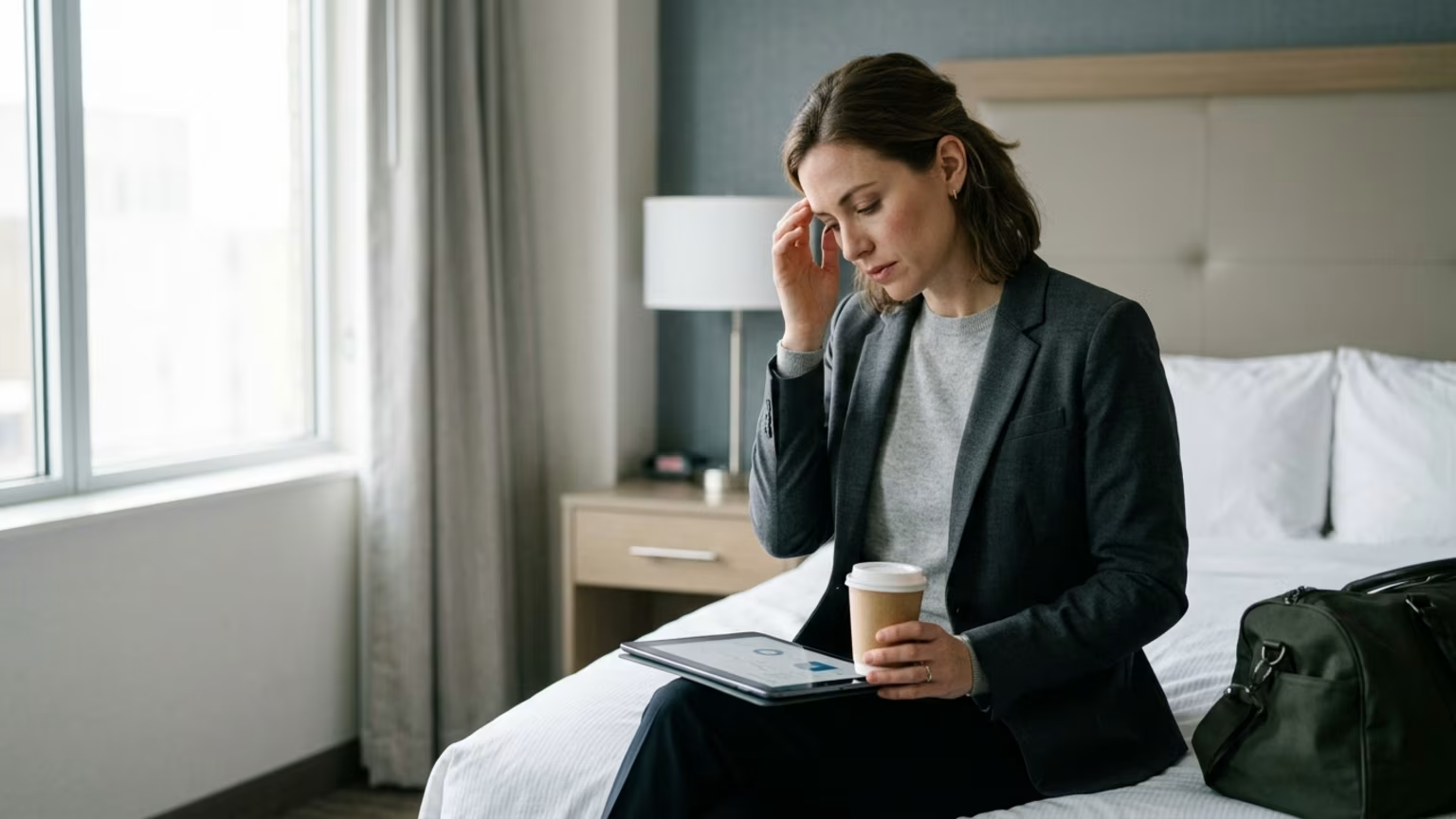

A 2026 Penn State study shows that bright, hot, or noisy bedrooms reduce sleep quality even when duration remains unchanged. Learn how executives adapt.





In 2026, the journal Sleep Health published findings from a Penn State-led study on environmental disturbances and sleep quality. Researchers analysed how perceived light, heat, and noise impacted young adults over a two-week period. The core finding challenges a common assumption about human rest. Participants reported significantly worse sleep quality when their bedrooms were too bright, hot, or noisy, even though their total sleep duration remained completely unchanged.
For ambitious professionals, this research clarifies a critical distinction between time spent in bed and actual physiological recovery. Wearable technology has conditioned many people to focus heavily on the total hours recorded. This study demonstrates that achieving a specific duration target does not guarantee restorative rest. Environmental friction can quietly degrade the quality of your sleep while leaving the total duration intact.
Operators must look beyond the clock to build a reliable recovery structure. Total duration is merely a baseline measurement. The physical environment acts as a secondary filter for the quality of that rest. Managing these variables is essential for maintaining sharp cognition during demanding workdays.
The Penn State team analysed data from 372 young adults with an average age of 22. These participants were drawn from the Future of Families Young Adult Sleep Study. The researchers designed a protocol that combined subjective daily reporting with objective technological tracking. For 14 consecutive days, the subjects submitted morning reports detailing their sleep experiences.
The participants noted whether light, noise, or temperature disturbed their rest during the previous night. Crucially, the study relied on wrist sensors to gather parallel objective data. These sensors tracked sleep timing, the time required to fall asleep, and total sleep duration. The researchers specifically focused on perceived environmental disturbances rather than fixed environmental metrics.
They did not measure light in lumens, noise in decibels, or temperature in exact degrees. Instead, they measured how the subjects experienced their physical space. This approach acknowledges that human sensitivity to environmental factors varies significantly. A noise level that wakes one person might go unnoticed by another individual.
By measuring perceived disruption, the researchers captured the actual friction experienced by the nervous system. The dual approach of sensor data and subjective reporting provided a comprehensive view of how environments shape recovery. This methodology highlights the importance of individual environmental perception over rigid statistical thresholds. It proves that personal comfort dictates physiological outcomes during the night.
Relying solely on objective room measurements might miss the actual biological stress occurring within the sleeper. Human perception acts as the final judge of sleep environment quality.
This distinction matters immensely for founders and executives who manage demanding professional lives. Many operators treat total sleep duration as the ultimate metric for physical restoration. They block out eight hours of time and assume the biological job is done. The Penn State findings suggest that duration alone is an incomplete scorecard.
A full night of sleep in a compromised environment may not provide the cognitive benefits required for high performance. Protecting your sleep and recovery requires active management of your physical surroundings. Co-author Orfeu Buxton noted that noise acts as a specific biological trigger. Parts of the brain remain alert to the environment during sleep.
The brain actively monitors for sounds that might signal a physical threat. This evolutionary mechanism means a noisy hotel room or a loud city apartment actively drains cognitive resources. Your body is working to process these inputs instead of entering deep restorative states. Executives must treat environmental control as a deliberate operational strategy.
Simple physical adjustments can protect the restorative value of your time in bed. Lead author Adwoa Dadzie suggested that people dealing with loud or bright rooms might benefit from basic structural changes. Earplugs, noise-canceling devices, sleep masks, and blackout curtains serve as highly practical tools. These are low risk adjustments that protect executive performance from unnecessary environmental friction.
When travelling or sleeping in unfamiliar locations, bringing consistent physical controls helps secure your baseline recovery. The goal is to build an environment that signals complete safety to the nervous system. You cannot always control the broader environment of a hotel or a new city. You can, however, control the immediate inputs to your eyes and ears.
The data revealed specific patterns based on the type of environmental disturbance. Perceived brightness showed a clear and negative association with rest quality. Participants exposed to bright environments experienced later sleep onset and increased wakefulness during the night. They also reported poorer overall sleep quality in their daily morning surveys.
The presence of unwanted light fundamentally shifted how their bodies moved into rest. Heat and noise created similarly disruptive patterns for the participants. Both factors were associated with poorer sleep quality in the daily morning reports. The wrist sensor measurements confirmed these subjective reports with objective physiological data.
The body simply struggles to complete its natural restorative cycles when it is fighting thermal or auditory stress. This physiological conflict occurs quietly throughout the night. The sleeper may remain technically unconscious while their brain constantly processes the background interference. This state prevents the deep biological repair necessary for sustained cognitive focus.
Interestingly, cold temperatures produced a distinctly different result. A room perceived as too cold did not affect sleep in any way detectable through the objective sensor measurements. The researchers emphasised that genuine sleep quality encompasses multiple distinct variables. It includes the time taken to fall asleep and the amount of wakefulness during the night.
It is never just about the total number of hours logged on a device. Duration without quality is a flawed target for any ambitious professional.
ExecuFuel prioritises intellectual honesty when evaluating new performance research. This study offers valuable systemic insights, but it carries clear structural limitations. The findings are strictly observational in nature. The researchers examined day-to-day associations rather than proving direct physiological causation.
The research provides a snapshot of related variables rather than a proven mechanical chain of events. A true causal relationship requires more rigorous testing methodologies. Furthermore, the study did not test specific commercial interventions. The researchers did not conduct trials using blackout curtains, eye masks, or earplugs to measure outcome improvements.
The suggestions to use these tools represent the researchers' professional interpretations. They are not treatment effects directly demonstrated by the study data. The Penn State university summary clearly stated that further research is needed. The sample demographic also requires careful contextual consideration.
The 372 participants had an average age of just 22 years old. The reporting noted that young adults often have limited control over their environments in dormitories or cramped apartments. The research team speculated that these younger subjects might have compensated for disrupted nights by simply sleeping in. This is a proposed explanation rather than a demonstrated biological mechanism.
Finally, the study did not measure long term professional outcomes. It does not prove that environmental adjustments directly improve longevity and healthspan or workplace productivity. It remains a focused study on sleep architecture rather than a comprehensive analysis of executive capacity. The exact metabolic consequences of these disturbances remain unmeasured in this specific trial.
Future studies will likely move beyond observational data to test direct clinical interventions. We expect to see controlled trials examining how specific tools impact objective recovery metrics. Measuring the exact effect of noise cancellation or thermal regulation on brain architecture remains a logical next frontier. The science of human performance increasingly demands precise data on how specific inputs change physiological outcomes.
For now, the available science encourages a more nuanced approach to daily rest. It shifts the focus away from simply counting hours on a spreadsheet or wearable application. Operators who want sustained energy and productivity must audit their physical sleeping environments. We anticipate that future health protocols will increasingly treat light and noise control as foundational elements of professional resilience.
Total time in bed is only the foundation of a successful recovery strategy. The physical environment dictates the actual quality of the rest you achieve. Managing this environment is a deliberate choice for long term capacity. High performing professionals should structure their sleep spaces with the same rigor they apply to their daily schedules.
Stay connected for research and practical guidance on executive performance, energy, focus, sleep, recovery and longevity. Ideas built for people who want to stay sharp, capable and effective for the long run.





Build habits and systems that support clear thinking, steady energy and long term capacity throughout a demanding career.
explore the Blog