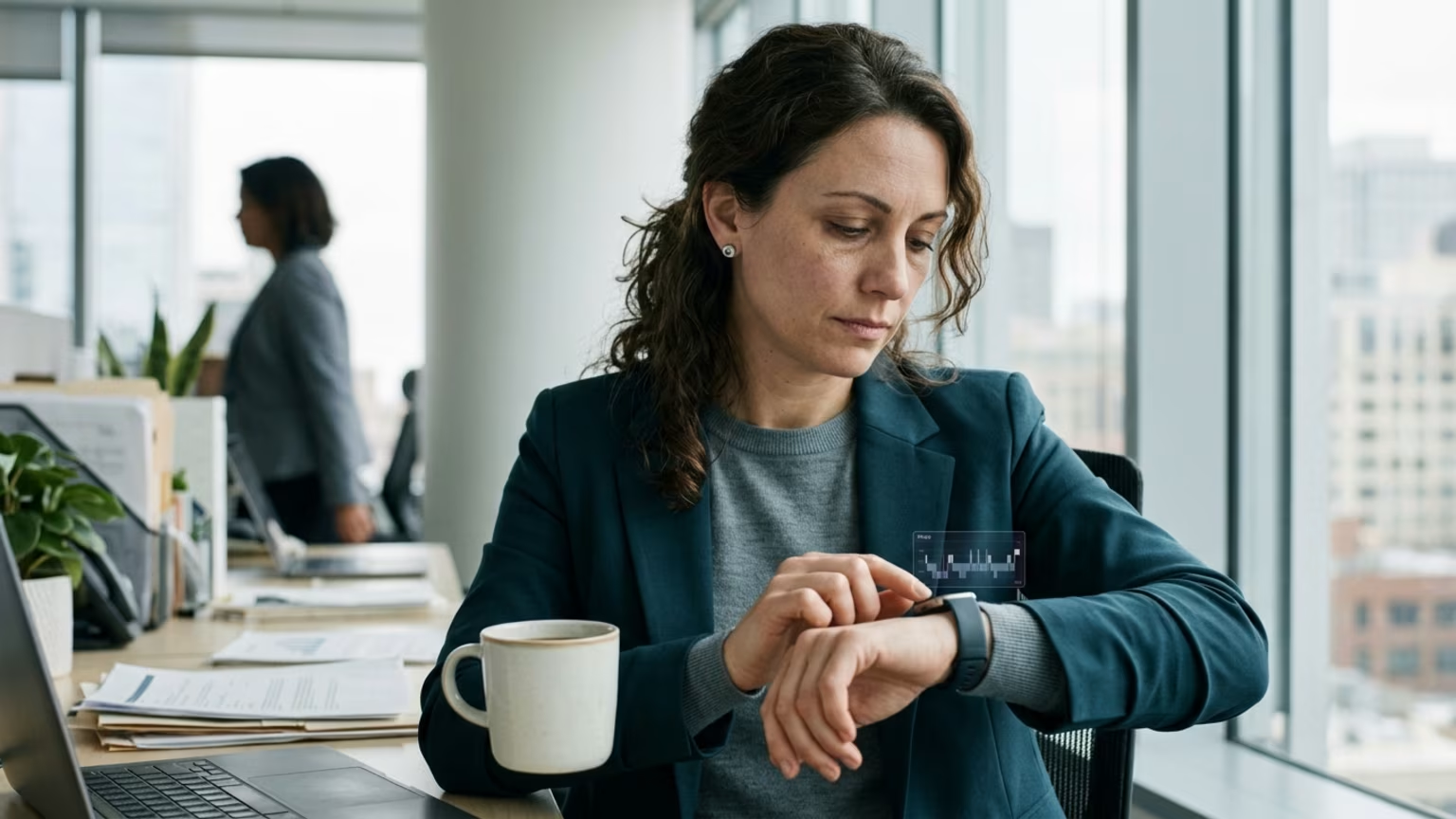

A new study of 462 working adults suggests personalized wearable sleep baselines may measure daily performance risk better than universal six-hour cutoffs.





Executive recovery protocols often fail because they rely on generalized population standards rather than individual behavioral realities. A rigid target of eight hours can create unnecessary anxiety for natural short sleepers. Conversely, a fixed six-hour minimum might leave others severely depleted. That mismatch between universal guidelines and personal requirements is why tracking long-term behavioral data has become vital for ambitious professionals.
On October 6, 2026, Medical Xpress reported on research detailing a highly individualized method for measuring insufficient rest. The findings are slated for publication in Sleep Medicine in 2027. Researchers at the National University of Singapore's Centre for Sleep and Cognition tracked 462 working adults for up to a year. The study protocol combined long-term Oura Ring estimates with daily smartphone assessments.
The report proposes moving away from a strict six-hour cutoff to evaluate sleep deficits. Instead, the authors argue for defining shortfalls relative to each person's normal sleep distribution.
The researchers compared the conventional fixed standard of less than six hours per night to a personalized threshold. This new metric was defined as one hour below the 75th percentile of a participant's long-term sleep-duration distribution. By using the 75th percentile, the threshold leverages the upper portion of a person's observed sleep distribution as a practical baseline. According to the report, this upper quartile acts as a reference for sleep obtained when occupational and social constraints are reduced.
The decision to use a one-hour decrement from this baseline was specifically informed by existing experimental sleep-restriction research. Both definitions ended up classifying a strikingly similar overall share of nights as short. The conventional six-hour cutoff flagged roughly 35 percent of the tracked nights across the study period. Meanwhile, the personalized threshold identified approximately 37 percent of nights as insufficient.
Furthermore, the median personalized threshold across the study was approximately 6.1 hours. This median sits remarkably close to the fixed cutoff. However, similar overall percentages did not mean the two approaches flagged the exact same people or nights. The report illustrates this by explaining that a person who usually sleeps longer might experience a meaningful shortfall while exceeding six hours.
Conversely, a habitual short sleeper might fall below the six-hour mark regularly without deviating from their established baseline. This personalized definition generated larger effect estimates across the day-to-day outcomes examined compared to the fixed six-hour rule. These tracked outcomes included alertness, sleep satisfaction, stress, and motivation. The researchers also measured sadness, sleeping heart rate, and heart-rate variability alongside sedentary behavior and physical activity.
Translating these findings into operator realities requires moving past universal targets. Ambitious professionals often face shifting occupational demands that dictate their nightly routines. Tracking metrics relative to a personal baseline helps executives manage their energy effectively during high-stress periods. The study suggests that an individual deficit is a more precise signal of performance risk than a generic population rule.
This insight allows leaders to build a reliable structure for managing their daily energy output rather than chasing arbitrary numbers. First author Chun Siong Soon cautioned that an occasional short night is merely a normal part of life. He emphasized that repeated or consecutive shortfalls may provide much more informative data for individuals monitoring their performance. Executives should focus on avoiding accumulating deficits rather than reacting drastically to a single poor wearable score.
This pragmatic approach supports maintaining sustainable cognitive performance across demanding business cycles. The authors frame their approach as a practical complement to population sleep recommendations. It is not intended to serve as a complete replacement for broad health guidelines. For high-performing teams, a personal sleep baseline serves as a tool to notice unusually short nights.
This relative metric allows operators to monitor variations in alertness and motivation through a highly personalized lens. This targeted awareness is critical for safeguarding mental clarity during intensive project sprints.
The research identified clear accumulation patterns regarding consecutive short nights among working adults. These patterns highlight how deficits actually accrue in real-world professional environments. Most personalized short-sleep episodes in the study were completely isolated events. For 86.4 percent of participants, the median run of personalized short sleep was exactly one night.
The report notes that longer consecutive runs of short sleep were progressively less common in the tracked data. Recovery patterns also showed distinct limitations during the standard workweek. Participants recorded approximately 50 minutes more sleep on the next weekday night following a single short night. However, they gained less than 10 additional minutes per night after experiencing further consecutive short nights.
Meaningful recovery primarily occurred over the weekend. During these two days, participants saw up to about 1.25 hours of additional rest. The study also documented stronger associations between a higher proportion of short-sleep nights and physical health indicators. Specifically, the report notes stronger associations with body roundness index and systolic blood pressure.
The researchers also observed stronger links to pulse-wave velocity and arterial stiffness. The negative effects on daily outcomes increased as participants accumulated successive short nights. The report detailed a separate analysis of anonymized data from 376,758 Oura users to examine these accumulation trends globally. This broad dataset covered individuals across Australia, Finland, Germany, and Japan.
The researchers also analyzed users in Singapore, the United Kingdom, and the United States. While country-level sleep patterns differed, the broader accumulation trends remained remarkably consistent. The broad pattern of isolated short nights, rarer longer runs, and limited weekday recovery was similar across all surveyed regions.
Intellectual honesty requires examining what this personalized metric does not actually prove. The personalized short-sleep threshold is not a direct measure of an individual's biological sleep need. The report notes that habitual sleep duration reflects sleep opportunity, occupational demands, and social obligations. It simply measures deviation from observed habits rather than physiological perfection.
Furthermore, the findings described throughout the report are strictly associations. The research does not establish that personalized short sleep directly caused the changes in cardiovascular-related markers or motivation. The report also does not provide numerical effect sizes, confidence intervals, or precise p-values for the outcome comparisons. Because of these omissions, readers cannot assess the precise magnitude of the reported differences from the document itself.
Therefore, professionals should not infer a quantified productivity benefit directly from adopting this specific threshold. The methodology also omits detailed participant demographics, occupational breakdowns, wearable adherence rates, and missing-data statistics. Those specific omissions limit any broad assessment of how perfectly representative this working-adult sample truly is. The cross-country analysis uses anonymized data without enough detail to prove those users represent the wider populations.
The case for personalization in this report centers on identifying specific individual nights and people. It does not argue that the personalized method labels drastically more nights as insufficient overall.
This research points toward a more nuanced future for physiological tracking and daily performance management. Senior author Michael Chee noted that standard population thresholds certainly remain useful for broad applications. However, he explained that months of individual data allow researchers to ask when someone is sleeping substantially less than usual. This transition toward longitudinal data evaluation represents a significant shift in how we interpret wearable technology.
Chee also stated that both overall sleep duration and the frequency of substantial personal shortfalls matter. Future clinical trials and industry applications will likely refine how these individualized baseline metrics inform executive decision making. The scientific consensus is moving away from rigid diagnostic criteria toward dynamic evaluation systems. These dynamic systems will continue to act as a crucial complement to established population guidelines.
Stay connected for research and practical guidance on executive performance, energy, focus, sleep, recovery and longevity. Ideas built for people who want to stay sharp, capable and effective for the long run.




Build habits and systems that support clear thinking, steady energy and long term capacity throughout a demanding career.
explore the Blog