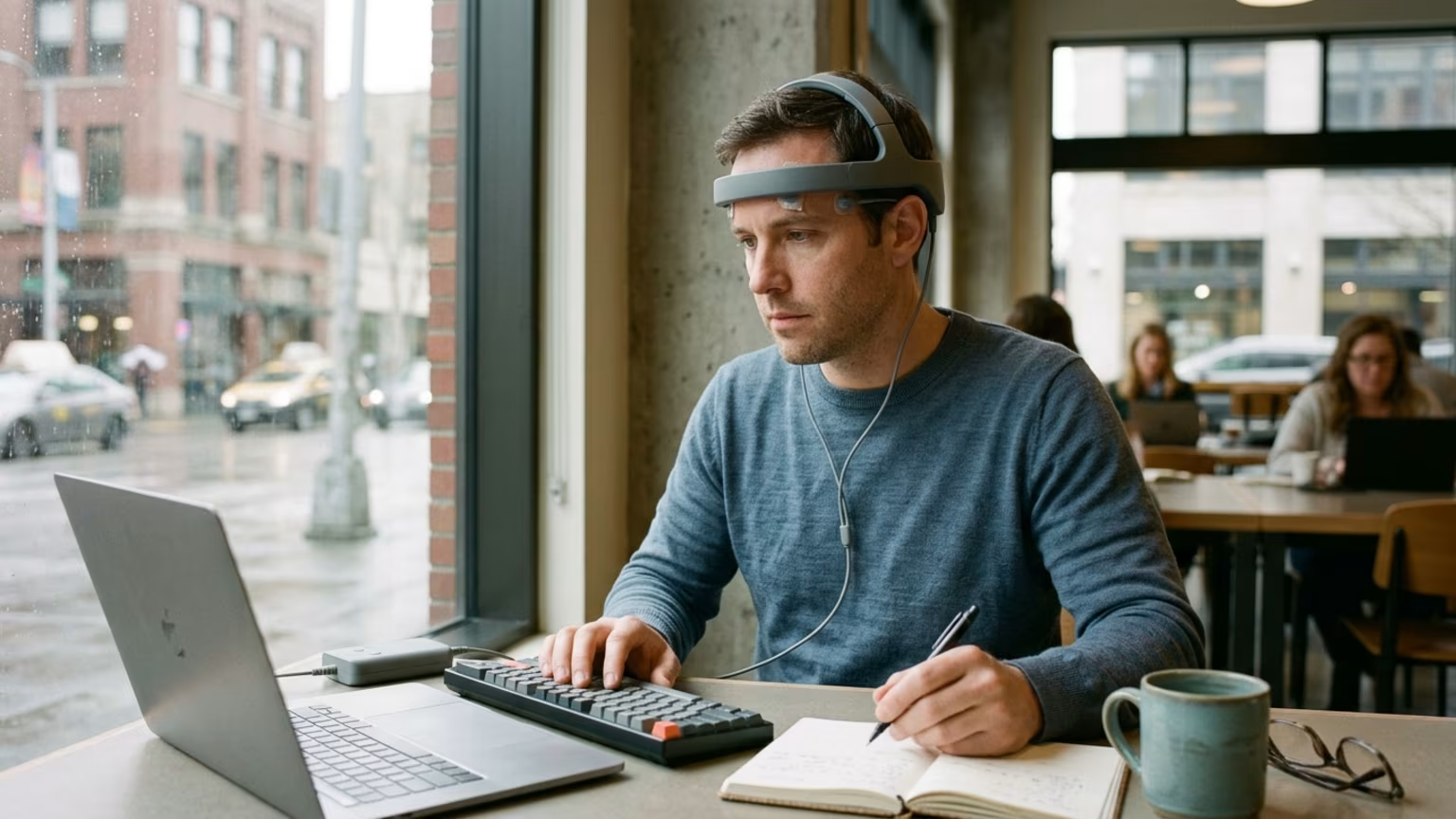

A recent Forbes Coaches Council article argues that executive performance requires managing cognitive and physical capacity, not just your calendar.





On September 30, 2026, a Forbes Coaches Council article presented executive performance as a question of leadership capacity. The author argued that senior leaders must manage this capacity rather than simply arranging their time. This perspective shifts the focus away from strict scheduling. It instead treats recovery and attention as fundamental parts of leadership practice.
For decades, the standard corporate approach to high workloads has been aggressive calendar management. Professionals often believe they can solve strategic exhaustion by finding blank spaces in their week. The newly published argument challenges this foundational assumption directly. True performance requires the biological and psychological resources to execute during those scheduled hours.
This conceptual shift is highly relevant for demanding professional environments. Operators frequently face a disconnect between their available time and their actual ability to focus. Addressing this gap requires moving beyond administrative solutions. It demands a structured approach to maintaining cognitive and physical energy.
The Forbes contributor describes leadership capacity through five distinct dimensions. These include cognitive, emotional, behavioral, relational, and spiritual elements. The author notes that the spiritual dimension refers to purpose and alignment with personal values. It does not necessarily denote any religious belief or practice.
To manage these five dimensions, the article proposes a five-part restoration cycle. This sequence begins with Retreat, Reflect and Refocus. It then concludes with Recharge and Re-engage. The model recommends deliberate distance from work alongside strategic reflection and prioritization. These steps are designed to break the momentum of constant execution.
The Recharge phase specifically emphasizes biological recovery practices. The author points to sleep, physical activity, nutrition, and meaningful breaks as critical components. These physical habits aim to restore decision quality and physical presence. Neglecting these areas compromises the other dimensions of leadership capacity.
Adjacent research highlights the physiological mechanics behind these recovery practices. A September 2026 report from McGill University describes a relevant peer-reviewed study. This research was published in the Proceedings of the National Academy of Sciences. It evaluated 54 healthy young adults who were kept awake for 30 consecutive hours.
The researchers divided the sleep deprived participants into three specific groups. Participants were assigned to a 20-minute cycling session, a 90-minute nap, or a control condition. This design allowed scientists to measure how different acute interventions affected cognitive performance. The study focused specifically on episodic memory retention under severe physiological stress.
For founders and operators, the central message is that calendar adjustments alone cannot fix depleted capacity. An executive might carve out empty blocks of time for deep work. However, poor recovery will still compromise their decision making during those blocks. Meaningful change requires structured recovery routines alongside traditional time management.
This philosophy aligns closely with the ExecuFuel approach to cognitive performance and mental clarity. Leaders must view physical restoration as a core business function. Attempting to force productivity through a depleted state usually generates organizational friction. The Forbes article highlights a specific coaching case to illustrate this dynamic.
The subject of the case study was an executive who maintained punishing hours. This leader reportedly worked from 5 a.m. through continuous meetings until 6 p.m. every day. He then continued to answer emails until 11 p.m. without taking meaningful breaks. During this period, he repeatedly revisited a single staffing decision over two entire months.
This kind of rumination is a classic symptom of cognitive fatigue. The executive possessed the calendar time to make the staffing decision. Unfortunately, he lacked the mental capacity to execute it with confidence. Restoring that capacity required a fundamental change in his operational cadence.
The author recommends tracking specific indicators to gauge performance capacity over time. These include observing repeated decisions, monitoring sleep quality, and assessing focus during critical conversations. Leaders should also solicit objective feedback from a trusted colleague. They can then review these collected observations after 30 days of deliberate practice.
Maintaining this awareness is essential for executive performance over the long term. A proactive approach allows leaders to identify fatigue before it compromises a critical project. Simple tracking mechanisms offer a practical alternative to complex performance diagnostics. They keep the focus on tangible daily habits.
The coaching case account details significant behavioral shifts within a relatively tight timeframe. The article reports that the executive changed his engagement with work over a three-month period. He stopped sending late-night emails entirely. He also set aside Tuesday mornings specifically for focused work.
Other structural changes included ending meetings a few minutes early to create transition time. These changes reportedly influenced the broader organizational culture around him. The article says two directors subsequently began protecting their own time. The modeled behavior gave the wider team permission to prioritize recovery.
Notably, the primary executive did not actually reduce his total working hours. The account attributes the reported improvements in decision clarity directly to his new boundaries. Changes in how he engaged with his work produced the positive team behavior. He managed to increase his output quality without cutting his overall schedule.
The McGill University report details specific statistical outcomes from the sleep deprivation study. The exercise and nap groups performed significantly better on the subsequent memory test. They scored about 22% better than the control group did. This highlights the measurable impact of acute recovery interventions.
A CNN report provides additional granularity on the specific image-recognition results for each group. The exercise group achieved a 56% accuracy rate on the test. The nap group scored slightly higher at 57%. Meanwhile, the control group achieved only a 46% accuracy rate.
The CNN account also notes a critical detail about the two intervention methods. It reports no significant difference in memory benefit between the exercise and nap groups. Both interventions provided a comparable cognitive buffer against the 30 hours of forced wakefulness. This suggests multiple viable pathways for acute cognitive preservation.
Executives must interpret these coaching frameworks and laboratory studies with appropriate caution. The Forbes article presents an anecdotal coaching framework rather than a formal clinical study. It lacks a control group or a quantitative outcome evaluation. The reported team changes are observational anecdotes from one specific business case.
There is no definitive proof that these practices will reliably produce identical results elsewhere. The suggested capacity indicators have not been validated as a formal assessment tool. They provide a useful observational framework, but they are not a psychometric standard. Decision repetition and sleep quality are subjective markers in this particular context.
Leaders should use these indicators to track personal baselines rather than objective clinical progress. ExecuFuel prioritizes clear distinctions between anecdotal coaching success and peer-reviewed medical data. The Forbes model is a practical heuristic, not a scientifically proven corporate intervention. Maintaining this distinction prevents overreliance on a single framework.
The sleep loss study also requires careful contextualization by operators. It offers only a narrow inference about acute laboratory conditions. The sample size was small and limited entirely to young adults. This demographic does not accurately represent an aging executive population.
Furthermore, the study does not establish that a short workout can replace adequate sleep. The findings simply show that brief interventions temporarily aided memory after severe deprivation. They do not validate a strategy of chronic sleep restriction supplemented by quick exercise. Long term sleep and recovery strategies remain essential for durable leadership.
Future performance research will likely continue to separate hours worked from actual cognitive output. We expect to see more longitudinal studies measuring the physiological markers of executive fatigue. Researchers may soon evaluate how specific recovery interventions affect complex corporate decision making. This progression will provide better data for leaders managing high stress environments.
The broader industry dialogue is moving away from sheer endurance toward sustainable biological capacity. This evolution acknowledges the severe limitations of traditional time management paradigms. Professionals require resilient systems for energy and productivity that respect their physiological limits. Tracking cognitive capacity will soon become as standard as managing a quarterly budget.
As the executive coaching sector matures, we anticipate higher standards of evidence. Coaching frameworks will increasingly incorporate objective biometric data alongside subjective behavioral observations. Wearable technology may soon validate the qualitative improvements reported in anecdotal case studies. This synthesis will give leaders a clearer picture of their operational readiness.
For now, the integration of physical recovery into leadership strategy represents a crucial competitive advantage. Operators who actively manage their capacity will sustain their focus over much longer time horizons. The shift from calendar scheduling to biological awareness is a permanent professional trend. Sustained impact belongs to those who respect their own physiological boundaries.
Stay connected for research and practical guidance on executive performance, energy, focus, sleep, recovery and longevity. Ideas built for people who want to stay sharp, capable and effective for the long run.





Build habits and systems that support clear thinking, steady energy and long term capacity throughout a demanding career.
explore the Blog