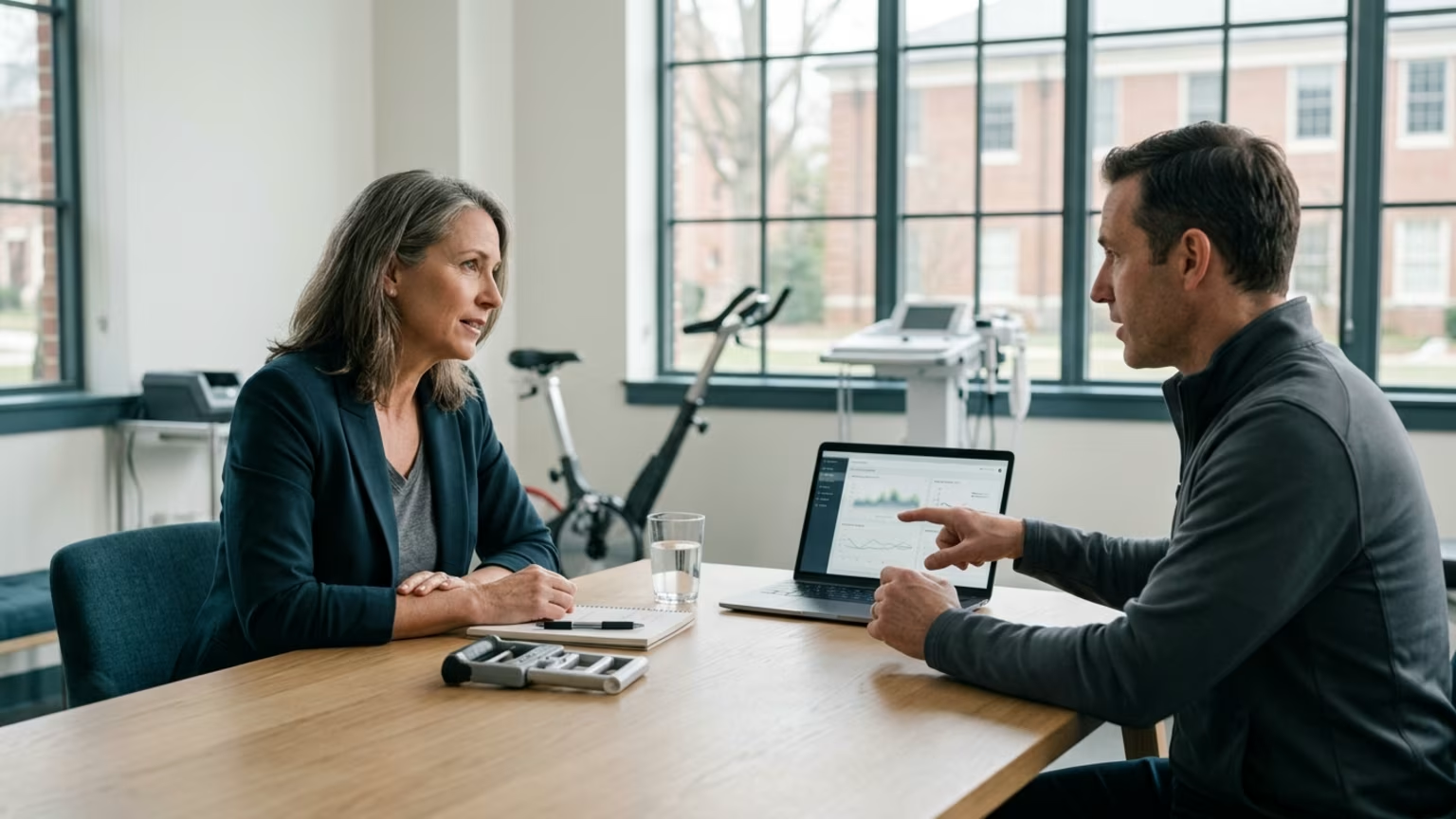
Recent reports highlight how carbon dioxide accumulation in poorly ventilated meeting rooms may contribute to afternoon fatigue and decision-making declines.





On October 6, 2026, Human Resources Director published a report highlighting a potential environmental factor behind afternoon fatigue. The publication noted that Logitech for Business ANZ warned employers about carbon dioxide accumulation in enclosed workspaces. The company warned that these gas levels could exceed 1,000 parts per million by mid-afternoon. Sean Byrne, the head of Logitech for Business ANZ, suggested that the widely recognised afternoon slump "could just be the air we're all breathing."
This statement frames indoor air quality as a measurable variable for modern businesses rather than a personal failing. The publication cited data from the climate-tech firm Carbelim to contextualise these workplace measurements. Carbelim reported that some crowded meeting rooms might even reach between 1,200 and 1,500 parts per million by the afternoon. These findings point to physical work environments as a significant factor in maintaining cognitive output.
To understand the relationship between carbon dioxide and cognition, we must examine controlled exposure research. A central reference point is a 2012 study published in Environmental Health Perspectives. Researchers designed a specific experiment to test decision-making under varying air quality conditions. The study placed 22 participants into an office-like chamber for isolated testing.
The scientific team controlled the environment carefully to manage specific atmospheric variables. They maintained a constant room temperature and a consistent outdoor-air ventilation rate throughout the experiment. The researchers exposed the participants to three different approximate carbon dioxide concentrations. These tested concentrations were 600, 1,000, and 2,500 parts per million.
This setup allowed scientists to observe performance changes without altering the basic thermal comfort of the room. The rigorous design is crucial for isolating the specific impact of the gas concentration. The researchers tested the subjects using nine specific decision-making scales to measure cognitive shifts. Indoor carbon dioxide is frequently measured as a rough indicator of outdoor-air ventilation per occupant.
When multiple professionals gather in a closed conference room, the gas accumulates steadily if the air exchange rate is low. The researchers used this chamber methodology to observe how varying ventilation proxies affect mental acuity. The primary goal was to determine if rising carbon dioxide could directly alter executive function.
Founders and operators invest heavily in building routines that support sustained daily focus. Leaders often attribute afternoon mental fatigue to poor nutrition, difficult tasks, or simply a long workday. The recent reporting suggests a more immediate environmental cause may frequently be at play. When executives spend consecutive hours in dense meeting rooms, the local air quality quietly degrades.
A rising carbon dioxide reading should serve as a prompt to evaluate room ventilation immediately. It is a practical operational signal rather than a permanent diagnosis of personal energy. You can read more about building resilient operational habits on our Cognitive Performance & Mental Clarity page. The operational response to these findings is straightforward and highly preventative for busy teams.
Long strategy sessions or intensive board meetings require adequate air exchange to support rigorous thinking. If a leadership team experiences a collective drop in energy, the meeting room itself might be the primary constraint. Managers should treat room conditions as a measurable component of Energy & Productivity. Monitoring the physical environment allows leaders to make fast adjustments to their immediate surroundings.
Simply opening a door, taking a brief pause, or increasing HVAC airflow can alter the trajectory of a critical afternoon session. Executives do not need to accept the afternoon slump as an inevitable physiological decline. By treating the workspace as a responsive tool, operators can remove unnecessary friction from their afternoons.
The reporting from Human Resources Director included specific environmental thresholds provided by Carbelim. The climate-tech firm characterised a reading of 1,000 to 1,500 parts per million as an indicator of poor ventilation. This specific measurement range is associated with reduced concentration among room occupants. When the concentration rises to between 1,500 and 2,000 parts per million, decision-making may begin to decline.
Carbelim associates levels above 2,000 parts per million with possible cognitive impairment. These ranges offer a clear framework for understanding how air quality scales directly with mental fatigue. The 2012 controlled chamber study provides additional statistical context for these specific thresholds. At a concentration of 1,000 parts per million, the researchers observed moderate decrements in participant performance.
Specifically, six of the nine decision-making scales showed statistically significant declines compared to the 600 parts per million baseline. The cognitive outcomes became substantially more pronounced at the highest tested gas concentration. At 2,500 parts per million, seven of the nine decision-making scales demonstrated large and statistically significant reductions. These distinct metrics demonstrate a measurable relationship between poor ventilation indicators and lower executive function.
Responsible performance management requires a clear view of specific evidence limitations before making sweeping changes. The 2012 experiment relied on a very small sample size of just 22 participants. These individuals were recruited primarily from a young university population rather than corporate settings. This demographic constraint limits how broadly we can generalise the findings to older executive populations.
The study authors explicitly stated that their experimental results require independent scientific confirmation. They also noted significant uncertainty regarding intermediate concentration levels and entirely different exposure durations. The cognitive effects documented in the chamber study were not uniformly negative across all measured outputs. One of the nine decision-making measures actually improved under the higher carbon dioxide concentrations.
Focused activity increased at the elevated 2,500 parts per million level. Furthermore, performance on information search tasks did not show a statistically significant difference across the various atmospheric conditions. This specific nuance argues against concluding that every form of mental output degrades uniformly in a poorly ventilated room. We must also recognise that indoor carbon dioxide can correlate strongly with other ambient indoor pollutants.
Changes in ventilation naturally affect the entire airborne profile of a working environment. An elevated carbon dioxide reading cannot definitively prove that the gas itself is the sole cause of mental fatigue. The real world relationship between a basic sensor reading and complex cognitive output remains highly multi-variable. Leaders should view these metrics as general indicators rather than precise biological triggers.
The conversation around indoor air quality is gradually shifting from building maintenance to cognitive support. Sean Byrne of Logitech for Business ANZ recommended that companies adopt environmental sensors to gather workplace data. These devices can track carbon dioxide and other airborne particles in real time during the workday. Making this data visible to managers allows for proactive ventilation adjustments before collective fatigue sets in.
This operational approach represents a practical step for companies managing dense office spaces. It provides a highly measurable way to manage physical environments during demanding work. We expect to see more organisations pilot environmental monitoring in their primary meeting spaces. The most cautious approach is to assess room readings alongside meeting duration and perceived physical comfort.
Future research will likely focus on large scale workplace trials to validate these early controlled findings. Until those broad clinical studies arrive, basic ventilation awareness remains a highly practical management tool. Leaders who understand the physical constraints of their workspaces can better support their teams through long schedules. Proactive environmental management may soon become a standard practice for high performing executive teams.
Stay connected for research and practical guidance on executive performance, energy, focus, sleep, recovery and longevity. Ideas built for people who want to stay sharp, capable and effective for the long run.





Build habits and systems that support clear thinking, steady energy and long term capacity throughout a demanding career.
explore the Blog